I practiced goshin-jutsu in NYC before shifting my interests to classical and traditional martial arts. Over time I wound up studying several approaches to Japanese swordsmanship. I learned portions of Tenshinshō-den Katori Shintō-ryū at Capital Aikidō from 2005 to 2015, reaching the level of mokuroku, and Kashima-shinden Jikishinkage-ryū at the Hōbyōkan beginning in late 2008, receiving a chuden menjo from David Hall in 2018.
Yuèshān-guan is the formal name of my ongoing training activity in Chinese internal martial arts — this is the most formal lineage I am part of. The same characters are read as Gassankan in Japanese. After moving to Seattle I engaged in pressure testing of my skill that helped solidify my choices in what and how to practice. I attempt to practice in a manner that I feel is compatible with my broader study of traditional internal martial arts.
I have evolved my practice over time to constrain my expression of kiai to be more akin to the vocalizations found in internal martial arts: flowing from, or aligned with, a movement, rather than driving it. I no longer forcefully coordinate breathing with each movement and instead stay relaxed, utilizing reverse breathing methods from Tàijíquán rather than the ibuki often used during traditional aun kokyu practice.
Emphasis is placed on developing a connected body that integrates force with each action in an optimal manner, remaining relaxed and able to adapt suddenly when needed. I practice this kenpō as part of the cultivation of shugyō (
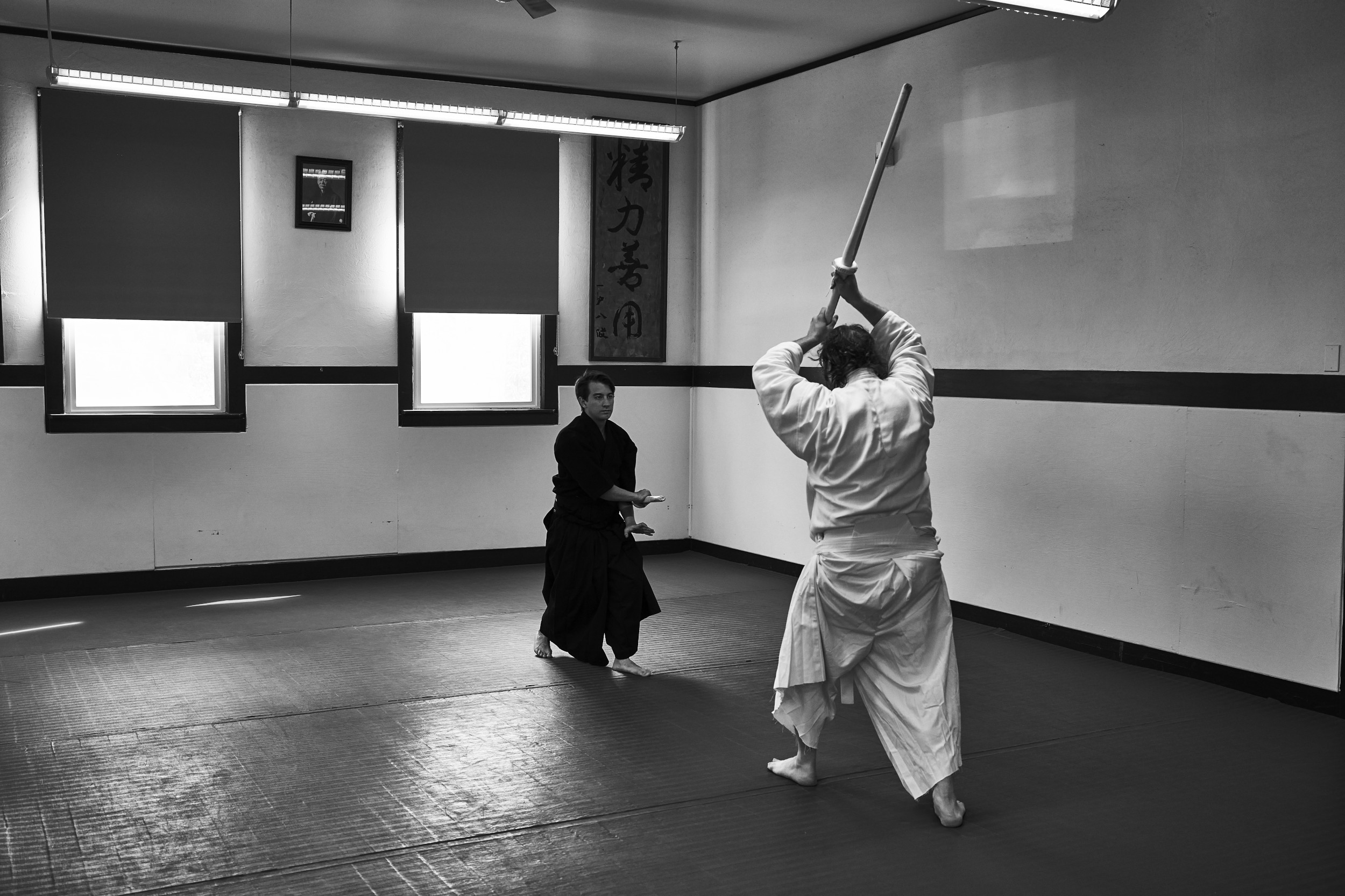
Two of my students have a firm grasp of the fundamentals of Jikishinkage-ryū in the way I was trained at the Hōbyōkan. They now maintain weekly keiko at Lonin League in the SODO neighborhood of Seattle. This is an unofficial line of transmission — links to several formal lineages of Jikishinkage-ryū can instead be found here.
Participation is open to interested parties with a serious commitment to preserving older martial traditions in a vibrant manner. Inquiries can be made through Lonin at the link above.