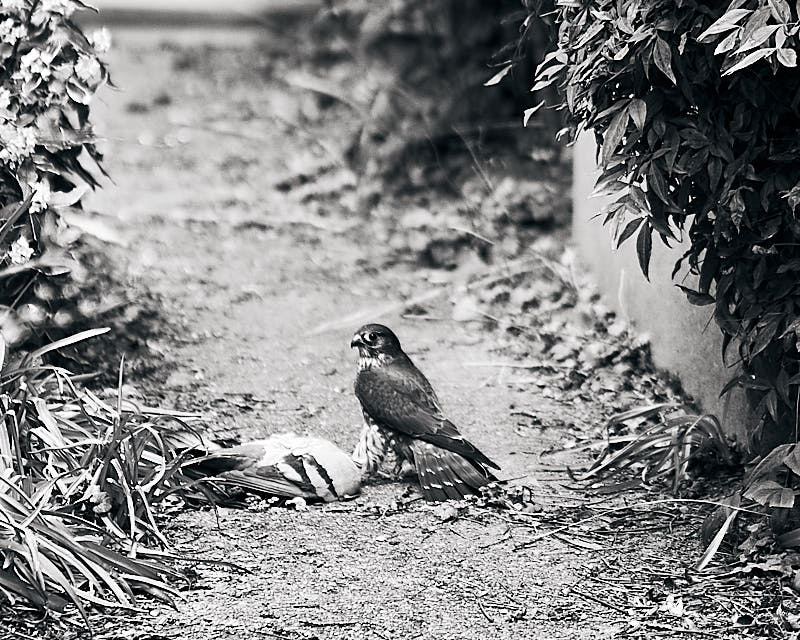
I was walking through the Phinney Ridge neighborhood of Seattle on a recent evening when I saw movement out of the corner of my eye. A small hawk had taken a pigeon as prey, and was standing immobile next to the larger bird. Somehow it was still there as I got my camera ready and managed to focus while the opportunity still presented itself.
In xingyiquan, half of the tactical forms of practice (i.e., the 12 animals) are named after birds of prey. In the Hebei xingquan, we practice cultivating the spirit and mental intent of each animal, as opposed to mimicing its external movements. This is in contrast to many other animal-inspired forms of Chinese boxing. The hawk I saw (which may have been an example of accipiter striatus) was motionless yet alert, in a strong example as I have seen recently of remaining or steadfast mind.
When I returned to the same spot, having completed my errand, the hawk and its prey had vanished without a trace. Opportunity can be as fleeting.
I. Opportunity
I feel the intensity of practice is waning in classical martial arts.
Summer is waning, the smoke in Seattle has cleared, and I pause to think about some recent interactions I have had with budo colleagues, learning about their path and the broader martial arts community:
- Some strong men and women are excited to learn new things, dedicating their choice of location and employment to be closer to a teacher they value.
- Others test their skill against younger, stronger opponents, in freestyle competition. And lose, but are wiser for the experience and in a different relationship with fear.
- A small few combine the essence of a sublime teaching with an art they have mastered to create something new and old at the same time, training assiduously and striving to constantly challenge themselves.
- Others attempt the same, and combine different arts to the detriment of both, winding up with less than they started with, because they were not ready for the task.
Through my network of colleagues, I often am sent video links to watch about this or that style of jujutsu or kenjutsu providing a demonstration. In years past, as I was excited to be able to see each different example, I didn't think much about quality per se, or intensity. But, when I watch demonstrations lately – and I admit, because of these issues I have been watching less in recent years – I feel like the posture and kiai and intensity of practice as demonstrated is generally weak.
Maybe too many people who focus on modern budo are "cross-training" with koryu and not giving up their first practice?
Some rather unique arts, that were known for their intensity, are now demonstrated as if they are a generic form of iaido or aikido. Arts that can only function with precise posture, distance, timing, and position are practiced in a sloppy, rushed, wavering manner. And I sit back at a distance and wonder how they cannot see the error of their ways? Easy to do from an arm chair. Maybe, with distraction paramount, I am not paying close enough attention to what I am seeing, often briefly, on a small screen, but some of the faults are so egregious, I wind up questioning the point of all of it.
If students publicly demonstrate high-level forms of an art in a formal venue, and then do so poorly, I think it is fair to say the overall quality of the art, in its current incarnation in that school, is poor. Because poor students were allowed to learn that material without mastering basics first. And there was also enough confidence in the students to allow them to demonstrate publicly. A person watching them might come to the conclusion that they should not train there. They themselves might be able to rise to a higher level at the same school, especially if they were good or would work harder than the people they saw, given the right opportunity, but it will be hard to blame them for coming to that conclusion. Because the first set of poor examples would be the senior members of the school, responsible for mentoring the next generation.
How does one undo that?
An art could have been good at one time, but with too many people training, or people training not often enough, without enough of a reason to let the art sink into their bones to the marrow, quality control can easily wind up being low. I don’t believe in the platonic ideal of a martial art – that somehow by sleep walking through practice, we connect with the founder(s) of the art. Only by bringing a similar intensity to our practice will we ever get close to the realizations they had, and make the arts our own. Too much budo winds up looking like generic Japanese jujutsu or kendo or iaido kata, versus it being somehow different and unique and special and different from what is commonly found.
All arts change over time, and the classical martial arts have also changed, maybe to a lesser extent than recreations or modern syntheses, but changed nonetheless.
Consider that gokui (inner teachings) of a martial art, what makes it really work, are typically hidden, but infuse the quality of the art in those who know them. You can’t infer the gokui from looking at a master do kihon (basic practices), but there is often something different about how they move, how they respond, that elevates their practice to a higher level. I don’t know what the gokui of different martial arts I have not practiced are (and maybe not of arts I practice – long is the journey), but I can tell something is better about certain lines of each art I am able to watch than others.
- Has your practice become overly ritualized?
- Relegated to an occasional hobby?
- Why do you practice?
Do you practice what I will call Enbu-do (the path of demonstration) instead of Bu-do (the martial path)?
When I look at people who are very good at martial arts, and then I enquire to what their training background has been, they each have gone through periods of their life when they had the focus and attention of a skilled teacher, and trained several hours a day, every day, for a period of years.
It is amusing to me that I have friends and training partners who have one or more of the same teacher (in one or more schools) and I will wind up with very different beliefs from them about what is good and bad about different martial arts. Everyone brings a different background and perspective to their practice, but I would have thought the experience of learning a particular martial art would have normalized those perspectives maybe more than it has or more than it can. One difference I have from some other of my contemporaries is that I have also been exposed to high-level martial arts from other cultures (for example, China), and the training methodologies and body mechanics of those arts. I think that colors the lens I use to evaluate what I am seeing in Japanese budo, and maybe I am unnecessarily harsh in my opinions at times. My colleagues who only practice Japanese martial arts may in turn be puzzled by all the time I spend on Taijiquan. But one benefit of that study is understanding more about relaxation, posture, focus, and balance that I wind up looking for in others. My experience in Jikishinkage-ryū also causes me to look for a focus and intensity in practice that I don't often see in other koryu. My guess is that at one time, a high level of focus and intensity was commonplace. Now, without focus or intensity, and without posture, balance, relaxation, or power, I am not sure what is left. Choreographed movements that are drawn from an earlier time, and would not work now, and would not work then? I don't think it is only modern "masters" of self-invented styles of Taijiquan that have something to fear from people who are young, healthy, and train hard at pragmatic approaches that provide direct feedback to the practitioners (e.g., Judo, Sanda, MMA).
I think it is important to keep kenjutsu practice alive, even if that means it should be somewhat changing or evolving over time. However, that does not mean losing its intensity. Otherwise, we are just practicing folk dance from Japan with swords (kenbu) — keeping the patterns we learned the same but not knowing if they can really be used, but absolutely certain that our folk dance is better than the other group’s folk dance, with no actual rationale for saying so.
That seems much less interesting to me, unless we just want to just do enbu-do instead of budo. I find especially grating discussions about the privations of medeival warfare, focusing on the resolve needed to travel many miles by foot, under harsh conditions, to the medeival battlefield, and how kenjutsu will provide the psychological and spiritual depths required to succeed in those environments, when the practitioners themselves demonstrating are slow and plodding, showing little power, spirit, or focus in their movements. If your art teaches skills for the medeival battlefield, own it. Maintain a warrior's body that honors the depths of the teachings you have received. Maintain a calm and steady mind that will provide you the discernment needed when you have to react quickly and suddenly to danger.
II. Outcomes
Traditional martial arts practices were developed during a period in history when outcomes mattered – sword practice, for example, was a matter of life and death. Practitioners both had more time available for practice and motivation to make the most of their efforts. Regardless of the fact that our contemporary environment is different than that encountered in the past, it is arrogant to assume we can spend less time on training, and change styles or teachers while still developing our skill. Focus is required to receive the fruit of our labor – often progress only occurs after a long period of effort and frustration. Training can be a profound struggle. There is a question of finding instruction from people who actually know what they are doing, which is hard enough in itself, as we are often not educated enough about the arts that capture our attention to know at the outset whether we are making a good training decision. I personally have spent years heading down winding alleys, whose corners yielded many surprises and delights, that ultimately gave way to impassible walls. In some ways, only that experience allowed me later to make better decisions about my training.
Even if by some chance a person happens across an art that preserves a high level of skill in a number of its practitioners, what of the prospective student? Do they have the basic conditions (fitness, mental attitude) needed to succeed? Can they spend the time required to develop a level of skill? Can they stay focused on the school long enough to succeed?
Listening to senior practitioners speak a bit about their students, both their pride and frustration often shows through. Strive to be the person they are proud of, and have little hesitation spending their time guiding further along the path. Daily practice and dedication is a prerequisite for taking full advantage of what journeymen instructors or great masters have to offer.
For me, as I begin to teach a bit more regularly, some of the same questions apply to the people I will spend time mentoring along their path. First, what I offer has to fit with their vision for their journey. Second, I have to think the time I will spend working with them will be meaningful for them, and provide me a mechanism to also further my own understanding and development. Because I am far from the top of the mountain, as far as skill is concerned.
To borrow a phrase from a great master, I do not want to waste anyone's time if the right conditions for training are not met. That doesn't help anyone. For my own sense of focus, and to honor the ideals I am attempting to cultivate, I will leave these essays in place, but will be spending my time training and considering longer formats with which to express my ideas.
I have not abandoned commentary, but please expect essays that are longer and more developed, less often. Meanwhile, consider the conditions that face your own development, the opportunities you have had, the choices you have made, and take time to reflect on paths chosen, abandoned, taken up again:
- What draws you to the arts you do?
- What makes you continue to train?
- How good are you?
- What challenges are you ready to take on?
- Are you setting your priorities so you can succeed?
- What can you do differently, to better cultivate what is required for success?
- How can you make your practice something that also benefits others?
A separate topic is how we judge the skill of those we encounter in the martial arts community. Students typically regard their teachers as skilled, otherwise they would not be training with them – somewhat tautologically. Why I enjoy about the HEMA community is that while in general the direct historical linkage provided by Asian martial arts is not present, more detailed writings survive on the arts as taught in their time period, and with a great deal of effort, and a modern (almost open source) mindset, a high level of skill has been evoked in that community in a relatively short period of time. It makes me wonder what would happen in the koryu community if the different groups decided to regularly get together and fight one another.
MMA and Judo/BJJ are similar, where a strong emphasis is placed on shiai. It is a bit of a fallacy to think there can be no free practice in traditional martial arts, due to the dangers inherent in their practice. At the same time, we would want our practice to retain the character of what it is, instead of regressing to the mean in an attempt to win at a competition. But, where grappling is concerned, or sparring with swords is concerned, I think there is more the koryu community could do as a whole to keep their practices alive.
Some arts do this, but they are arduous, and do not attract many practitioners. People who excel at arts of good repute might quickly fail out of that kind of training evolution, once randomness and freedom are introduced. The familiar can become unfamiliar, and with freedom comes a proportionate amount of stress introduced into the practice. I am not sure each traditional martial art is capable of taking anyone interested on an intellectual level and bringing them to the correct mindset, without an external threat of conflict that would drive practice and an associated practice to allow the mind to stay focused and relaxed.
People have to have the right mindset in them, either instinctively, or through acculturation via specific methods of training. Hojo is one of those (and it is but one, particular to an art I practice). This is one reason why one might spend so much time on fundamental portions of a curriculum, before examining elaborations on a theme. In that regard, I feel that it is the smaller groups that often are stronger than those attracting many participants, as care must be taken to ensure a correct mindset is present, if what we are talking about is traditional swordsmanship. Often the basic practices of a tradition contain the hidden essence of the most profound, and when we see the full picture, after many years of study, we realize that what is seen is but the surface of a deep well of knowledge. Only by revisiting what we once thought we mastered can we begin to appreciate the full depths of our art.
Logic is often all too lacking in the martial arts. There are many challenges a martial artist will face that benefit from critical thinking – deciding on an art to practice, finding a good teacher, deciding if a group is no longer the right one, discerning the right training path based one's personal capabilities and interests – these are but some of the decision points a martial artist faces in their career. Given the above, is there a consistency to how we decide what to practice, what to let go, how to focus our training, and how to measure its results? Below I will speak to some traps that are all too common and suggest a possible way through the maze of choices we are presented with in training in the postmodern age.
III. The danger of self-referentiality
It is dangerous in martial arts to become overly self-referential in one's training. If you practice inside a closed ecosystem and never stress what you are doing, how will you understand your limitations and the limitations of your tactics and how to distinguish between them? Without that knowledge, it is hard to continue to grow past a certain journeyman level of skill. Traditionally, the role of the senior (e.g., uchitachi) is to provide this critical feedback, but when on one's own, after gaining a measure of skill, how to self-evaluate becomes extremely important. This is why what we call classics in Chinese martial arts are important – to provide a connection to the inspiration of the founder of an art, so that the art can be living inside of you, possessing you fully, instead of a dim echo of the original insight, lost through the caverns of time.
Many people practice martial arts for the feeling they get of being associated to a particular group, and while it is important to learn from skilled teachers, one also should stand by one's own skill, and not make excuses for it. A parody:
"My art is deadly, but I could not possibly spar you, as I would then be kicked out of my very elite school. We are the best swordsmen in the country and I have been training for thirty years, but I could not risk the ire of my teacher, as I am but a student of this wonderful art."
To what end, then, practice? To preserve the idea of a combative art, or the art itself? Can the art survive outside of combat? What benefits (e.g., physical, psychological, spiritual) does it bring? In something like swordsmanship, where we are divorced from the historical impetus for the art, are we simply building up our ego in aspiring to master the art?
This is all a long way to say that on one hand, it is okay to take the time to learn deep approaches to armed and unarmed combat, and serve within the rules of a group in doing so, but one should eventually also be willing to explore the approaches you believe to have mastered in some kind of stress tested environment. Starting within a group is a start, but being willing to face others is important. The only things a person loses in doing so are the preconceived notions of their skill. Doesn't that free you, instead of harm you?
Yes, it is true that we can't actually practice battlefield kenjutsu in the modern age, but we at least can get feedback on our own skill in progressively aggressive sparring. Doing this cannot be something done at scale – once there is too large of a community involved, there will be regression to the mean, and approaches will evolve to win at specific instantiations of rules governing any set up of matches. Witness kendo, or Olympic fencing. I am not advocating that progression, but instead a willingness to work hard and experiment.
However, the idea of stress testing is a double-edged sword. It is also dangerous to become overly distracted with competing approaches to the point where you train in so many different approaches, you are effectively no longer training at all, because the efforts are not aligned, and cancel each other out as opposed to balancing or reinforcing one another. Training runs a danger of becoming irrelevant if you spend too much time switching approaches, running from shiny object to shiny object. This is where teachers can be helpful, pointing out how to approach an opponent using a different methodology, from one's own practice.
IV: Open Steel
I would like to describe a bit of my approach, which stands in stark contrast to much of what I describe above. I have taken photos of longsword competitions in previous years and enjoyed watching the fitness and skill of the practitioners. This last weekend I took the step of entering into the Swordsquatch Open Steel competition so I could experience the action first hand.
While I do not actively practice HEMA, I am a member of the Lonin collective and use their training space to work on my Chinese and Japanese weapons practices. One of the early Lonin members practices another koryu, and he and I engage in free practice to further our own training. The opportunity to spar members of other ryu is rare, and generally discouraged in koryu communities. I am also a practitioner of Chinese swordsmanship, where the idea of sparring is not verboten, and Jikishinkage-ryū was known for its aggressive, sparring heavy, approach to mastering the sword. In any case, I have found doing so very useful. We have adopted using some components of HEMA armor for our sparring sessions, as they can stand up to the abuse provided by the Nen-ryū fukuro-shinai (leather wrapped bamboo swords) we use. I have started reading through some of the available manuals on European Longsword available and last fall attended the open mat session at Lonin called "Fight Night", where members of different HEMA groups spar in a collegial manner.
I found the experience exciting and engaging and found it interesting to adapt to the increased distance and speed (the "Feder" is lighter than the weapons I typically use, for safety reasons) found within the Italian and German longsword practices. I enjoyed sparring people I had not met before and trying to adapt to their individual styles without much prior knowledge of what they would be doing.
The way I cut in kenjutsu and Chinese swordsmanship is a bit different than is common in HEMA; with proper body organization it is possible to generate sufficient power with smaller movements than are used in HEMA, but it takes a long time to develop that kind of skill. It is part of what makes those arts so special. So, I did not score well in the matches, but did manage to keep my focus and intensity and looking at the video footage, am generally pleased with how things turned out. I was there to experience freestyle sparring at speed with new opponents, and test my skill. That much I accomplished.
In the spirit of owning it, accepting strengths and limitations, striving to exceed the latter while developing the former, and taking the good with the bad, below are links to my matches:
Some thoughts. If I were to do this more often, I need to learn better the angles of attack at range to be able to protect myself better, given the speed at which the feder (feather) sword can move. I was happy with my ability to close and to uproot opponents backwards to make room to cut; a challenge with the rule set is how small the rings were. Part of how I fight involves closing with an opponent, removing their options by getting them off-balance, and then cutting them. One way to do the latter is to drive them back using body organization and cut. In my matches, I found that driving someone back to do this often took them out of the ring, calling a halt to the action.
I did succeed in executing two throws spontaneously, drawing on my Taijiquan, using an arm entangle and stab from Bagua Jian, and in escaping from an arm grab at close range. So, some of the Chinese Internal Martial Arts skills are coming through for me in free practice. The mat was a bit slippery and I lost my footing once. At least my opponent was moving backward and out of range when that happened, but falling was much less than ideal.
I found the continuous format very intense, as it required a great deal of stamina to stick with the flow of battle while wearing the relatively heavy armor and protective gear. I am glad I have been bicycling up hills recently. The ring, however, was a bit small to maneuver in, and caused many of the engagements to start too close. I would like to be able to do a similar format with more space as often by the time I was able to drive a person back, they were out of the ring.
I think I will make time to attend Fight Night in the future, maintaining an esprit de corps with the other groups at Lonin. The open steel format is different enough from what I am trying to develop in my YCGF and my kenjutsu practice that I am not sure I would optimize for it in my training, and make a point to start entering HEMA tournaments regularly, but they are a great resource that I want to point out exist for testing one's spirit, especially to the koryu community.
I think most koryu practitioners would find doing so useful as a calibration, even if not part of their regular training. While it is fair to require a practitioner obtain a level of skill before sparring freely inside a group or with colleagues who practice other martial arts, sometimes this never happens. Traditionally, this was upon receipt of a menkyo, or license, suggesting a level of skill had been obtained in an art. However, today, these certifications are much harder to come by, both due to the amount of time hobbyists are able to practice and the commoditization of martial arts in terms of their forms or kata. Saying someone has completed training gives them the freedom to exist on their own, and implies to at least some extent, a loss of control of their behavior. How many people, excited about the accomplishment they have obtained, think to continue to benefit from the wisdom of more seasoned travelers on their path? How many instead think they are truly complete? How many of those have stress-tested their approach and know the strengths and limitations of their practice?
V: Conclusions
It is important that our training be a crucible, forging our body, mind, and spirit under carefully designed pressure. To increase your chances for success:
- Take care to walk a path that is worth traveling. Head towards the cleanest line, even if it is the steepest.
- Seek guidance along the way: from those who have walked your path before, from those on other routes that cross your own briefly, or from unexpected places.
- Feedback, even if painful, is crucial to progress.
- Be worthy of the journey. Give more than you take – if your focus is entirely inward, on what you can get, you may as well not have walked the path at all.
- Don't quit when difficulty ratchets up. The difficult, crux moves, are what change you.
- Every art lives in a single generation – the current one. Don't rest only on the stories of those who came before. Strive to match or exceed them.
Can these maxims serve as a crucible of their own, lifting ourselves from the realm of pastimes to a deeper artistic endeavor, where we each have a purpose and a statement and a vision of what we want to accomplish, beyond the social circle (salon, coterie, dojo) we inhabit? Only time will tell, and then so only if we have some kind of logic or decision procedure so that we can have a chance of noticing failure from success.
If you practice more than one approach, what is the common theme that transcends the individual arts? How do the strategies align or diverge between different arts? It is all well and good to do the kata of each art correctly. One can probably succeed in doing that well enough, so that only master level practitioners can notice the influence (or contamination) of different themes. The leitmotif of Shinto-ryū in my Shinkage-ryū . Kaito affecting nagashi. Furi in turn affecting makiuchi. Is one the ura to the other's omote? How do they reinforce one another? How do they cancel? Can they be in balance? Should one be abandoned? Retained? Transformed?
Internal arts an excellent case study. For a long time I have been critical of the over simplification of identifying the dialectic of internal/external with good/bad or high-level/low-level in martial arts. There can be poor practitioners of taijiquan just as there can be good practitioners of tantui. But moving beyond that, a question is how to integrate practices into other arts, either to replace what may have been lost, or improve one's expression of the art. Doing so as a student may yield benefits (e.g., in the case of people adding body and breath training methods to their Aikido or Daito-ryū , when Ueshiba and Takeda likely used those methods in their own development) or cause harm to the art (e.g., attempting to do Katori with ideas drawn from Taiji and keeping the rapid furtive pace and large distance between uchi and shi, when those facets of Katori are in conflict with Taiji principles). A question to keep in mind, and I think often ignored, is whether by adding to a practice, you diverge so much you are no longer doing the art. The ability to shape shift mentally, keeping the body development you have (you have one body) but organizing your movement in line with a single art at a single time, may allow you to continue to advance in each practice separately, but it is a hard road to walk. If you are senior enough to be a teacher, you can simply change what you teach. If not, how long can you exist inside the confines of the structure (physical, mental, social) presented you? Do you go off on your own? When? What do you gain by doing so? What do you lose?
Another question is how to know what is compatible with ideas drawn from other sources. If, for example, reverse breathing practices are added to your art, does it change the way you cut? A glance at Jikishinkage-ryū versus Kashima Shinto-ryū says very much so; closer still, compare the former to Yagyu Shinkage-ryū , especially where a large number of shinai gekko kata are practiced with a very light implement. In the same spirit, compare Kashima Shinto-ryū to modern variants of Katori Shinto-ryū – the latter having preserved possibly more sets of kata (iai, bo, naginata, yari) but evolved to place a priority on celerity, to the point of using a bokuto that is no longer representative of a sword, weighing half as much (e.g., 600g vs 1300g). How does that aesthetic choice affect the movements and assumptions of its practitioners?
I myself am in the process of striving and focusing. Striving forward to get a deeper understanding of the arts I have chosen to focus on, and focusing the teachings I practice. They each have intrinsic value but in an instant, you cut once. You do not get to pick Shinto-ryū or Shinkage-ryū or Jikishinkage-ryū . For me, internal martial arts is the core of my practice, so only what I am able to align with those ideas should survive the process above. All of this requires looking past individual technique and dedicating to a small set of paths.
Some final thoughts, as best as I can manage. Be the person on the cliff, taking the cleanest line, not the someone wandering around the base of the mountain, trying the beginning of a route and backing down, over and over again. Seek out the greats and benefit from their wisdom, but do so in a manner that brings a level of competency in an approach to your own being, so you are someone worthy of that experience.
A collected set of works on Shinkage-ryū heihō is available as a book: The Truth of the Calm Spirit: The practice of Shinkage-ryū Heihō as Taoist Internal Alchemy, 2025.