Introduction
Students typically regard their teachers as skilled, otherwise they would not be training with them – somewhat tautologically. One thing I enjoy about the HEMA community is that while in general the direct historical linkage provided by Asian martial arts is not present, more detailed writings survive on the arts as taught in their time period, and with a great deal of effort, and a modern open-source mindset, a high level of skill has been evoked in that community in a relatively short period of time. It makes me wonder what would happen in the koryū community if the different groups decided to regularly get together and fight one another and prioritized basic training (i.e., fitness) in addition to pattern practice.
It is a bit of a fallacy to think there can be no free practice in traditional martial arts, due to the dangers inherent in their practice. At the same time, we want our practice to retain the character of what it is, instead of regressing to the mean in an attempt to win at a competition — this is a structural challenge with simply cross-training in Jūdō or MMA or HEMA to bring pressure testing into one's practice. One is pressure testing Jūdō or MMA, not their koryū or other classical practice. Doing so might benefit the latter, but a lot of work on integration of what one learns through the process is still required. Regardless, where grappling or sparring with mock swords is concerned, I think there is more the koryū community could do as a whole to keep their practices alive.
Some arts do this, but they are arduous, and do not attract many practitioners. People who excel at arts of good repute might quickly fail out of that kind of training evolution, once randomness and freedom are introduced. The familiar can become unfamiliar, and with freedom comes a proportionate amount of stress introduced into the practice. I am not sure each traditional martial art is capable of taking anyone interested in older approaches to training and culture on an intellectual level and bringing them to the correct mindset, without an external threat of conflict that would drive practice and an associated cultivation of how to keep the mind focused and relaxed during times of danger (through posture, breathing, visualization, incantation, or other means).
Solitude
In my own case, after moving to Seattle in 2016, training was very different from before. Mostly, I spent my time at solo practice and visiting internal martial arts colleagues periodically to work on Baguazhang and Tàijíquán applications.
I initially had no one to practice formal kenjutsu kata with. However, I did find a sparring partner who trains in a different tradition than my own who was interested in free practice, with the blessing of his teacher. We used heavy Nen-ryū style fukuro shinai popular among Kashima Shinryū, along with Lacrosse goalie gloves and HEMA fencing masks. I found kendo masks (men) and gloves (kote) do not protect well enough for what we were doing. I found the activity to be a very useful laboratory to explore all the things I have learned over the years, at Hōbyōkan and elsewhere.
I noticed that for me, Shinkage-ryū works much better than Shintō-ryū in free sparring, although bits and pieces of Shintō-ryū seem to be effective when just outside of grappling range. This has caused me to more and more focus only on Shinkage-ryū over time.
My kenjutsu training for a time wound up focused on gaining fighting experience and working on body conditioning, and over time I hoped to get people to work with further on skill development (including formal kata). The reason the sparring sessions seemed to be working for me is we were both committed to our individual arts and exploring how to use them, rather than deviating from them when we had trouble, simply in order to win.
Insight
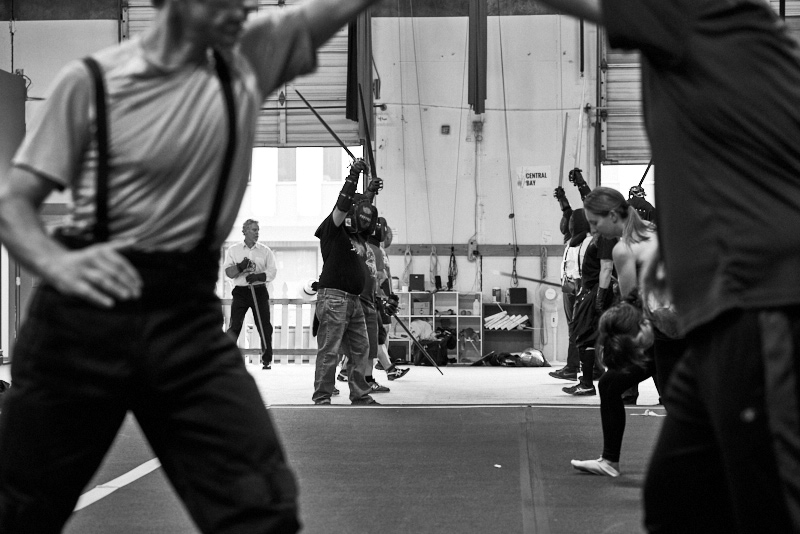
I had the good fortune of being able to participate in Fight Night at Lonin, a HEMA collective in Seattle. Fight Night is an open sparring session where HEMA groups can get together to spar with light steel weapons. I acquired a fencing jacket, neck protector, padded pants, shin guards, gauntlets, back of head protector, neck protector, and a steel blunted longsword and joined in their open fight night. The longswords are about 42 inches long so the distance is closer to a larger Chinese jian or a Japanese odachi (greatsword) than a Japanese tachi (sabre), so it took some getting used to.
I was learning about how the HEMA community evaluates engagements and it gave me insight into portions of my kenjutsu. In Jikishinkage-ryū to no kata, there is a finishing sequence to many of the kata where the participant (shidachi) jumps back into a high guard (jōdan) after delivering a finishing blow. For many years I didn't really understand the motion, even though I noticed high-level kendōka using the movement after scoring in some of their matches. The jump back in to no kata finally makes sense to me. In HEMA, after you score, the other person can counter-strike. If they hit you, your point gets knocked down a category due to what is known as a failed withdrawal. The idea is to always protect yourself, because you don't know how someone will react once they are hit. If they have armor, you may not know if your cut will penetrate until after they have a chance to hit you. So, once you strike, you need to cover, as there could very likely be a counter-strike of some kind.
At times in sparring I could use some tactics well, despite having to adapt to a different distance and tempo. I was practicing Chinese sword with the steel longsword (called a feder or “feather” sword) to get the movements facile (there is a cross-bar type guard that one must be cognizant of as jabbing yourself in the eye is not to be desired). Over time, I worked on Shinkage-ryū in the same manner.
Swordsquatch: HEMA Tournament and Gathering
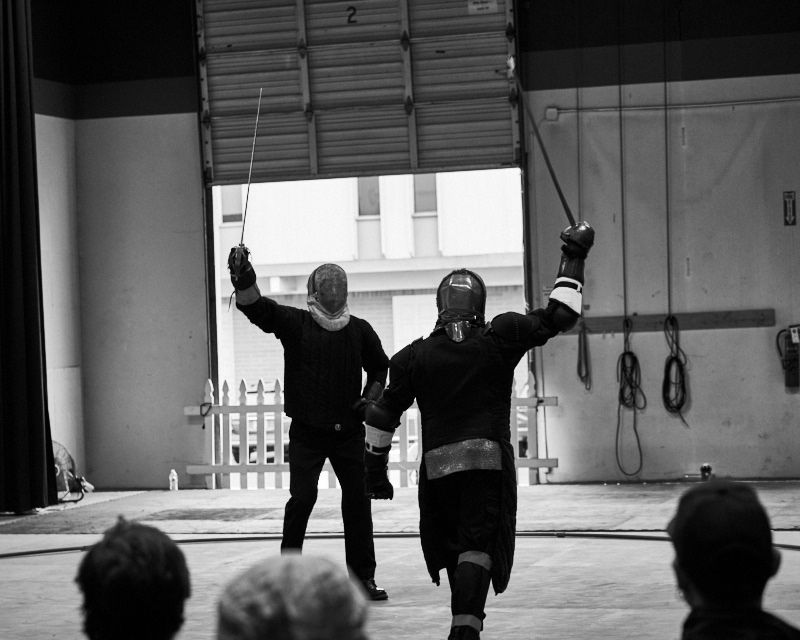
I also attended Swordsquatch and took excellent classes in bō (staff) from Ellis Amdur and in wrestling from Mike Panian of Swordfighters, BC. The level of swordsmanship among experienced HEMA practitioners I witnessed at the open steel tournament finals was quite high. They have gotten a lot of mileage from studying the existing texts, rigorous experimentation, and hard physical training. It was refreshing to watch, especially noticing how genuine and down to earth the people seemed to be at this event. A person I sparred with at Fight Night wound up taking second place in the men's open steel longsword tournament at Swordsquatch, so there is clearly a lot of skill to work against in their group.
English Backsword Sparring
I have some photos available here. I am delighted one of them was chosen for The Stranger's article on the event.
In late 2018 I took the step of entering into an Open Steel longsword HEMA competition so I could experience the action first hand.
While I do not actively practice HEMA, I found the experience exciting and engaging and found it interesting to adapt to the increased distance and speed (the feder is lighter than the weapons I typically use, for safety reasons) found within the Italian and German longsword practices. I enjoyed sparring people I had not met before and trying to adapt to their individual styles without much prior knowledge of what they would be doing.
The way I cut in kenjutsu and Chinese swordsmanship is a bit different than is common in HEMA; with proper body organization it is possible to generate sufficient power with smaller movements than are used in HEMA, but it takes a long time to develop that kind of skill. It is part of what makes those arts so special. So, I did not score well in the matches, but did manage to keep my focus and intensity and looking at the video footage, am generally pleased with how things turned out. I was there to experience freestyle sparring at speed with new opponents, and test my skill. That much I accomplished.
In the spirit of owning up to intensity needed for proper training, accepting strengths and limitations, striving to exceed the latter while developing the former, and taking the good with the bad, below are links to my matches:
I was happy with my ability to close and to uproot opponents backwards to make room to cut; a challenge with the rule set is how small the rings were. Part of how I fight involves closing with an opponent, removing their options by getting them off-balance, and then cutting them. One way to do the latter is to drive them back using body organization and cut. In my matches, I found that driving someone back to do this often took them out of the ring, calling a halt to the action.
I did succeed in executing two throws spontaneously, drawing on my Tàijíquán, using an arm entangle and stab from Bagua Jian, and in escaping from an arm grab at close range. So, some of the Chinese Internal Martial Arts skills are coming through for me in free practice. The mat was a bit slippery and I lost my footing once. At least my opponent was moving backward and out of range when that happened, but falling was much less than ideal.
I found the continuous format required a great deal of stamina to stick with the flow of sparring while wearing relatively heavy armor and protective gear. The ring, however, was a bit small to maneuver in, and caused many of the engagements to start too close. I would like to be able to do a similar format with more space. The open steel format is different enough from what I am trying to develop in my YCGF and my kenjutsu practice that I am not sure I would optimize for it in my training, and make a point to start entering HEMA tournaments regularly, but they are a great resource that I want to point out exist for testing one's spirit, especially to the koryū community for those willing to step outside their comfort zone.
These experiences — sparring colleagues from different traditions, joining Fight Night, watching and entering HEMA tournaments — sharpened something that had been troubling me for a while. I feel the intensity of practice is waning in classical martial arts. Through my network of colleagues, I often am sent video links to watch about this or that style of jujutsu or kenjutsu providing a demonstration. In years past, as I was excited to be able to see each different example, I didn't think much about quality per se, or intensity. But, when I watch demonstrations lately — and I admit, because of these issues I have been watching less in recent years — I feel like the posture and kiai and intensity of practice as demonstrated is generally weak. Maybe too many people who focus on modern budō are “cross-training” with koryū? Some rather unique arts, that were known for their intensity, are now demonstrated as if they are a generic form of iaidō or Aikidō. Arts that can only function with precise posture, distance, timing, and position are practiced in a sloppy, rushed, wavering manner. And I sit back at a distance and wonder how they cannot see the error of their ways? Easy to do from an arm chair.
If students publicly demonstrate high-level forms of an art in a formal venue, and then do so poorly, I think it is fair to say the overall quality of the art, in its current incarnation in that school, is poor. Because poor students were allowed to learn that material without mastering basics first. And there was also enough confidence in the students to allow them to demonstrate publicly. A person watching them might come to the conclusion that they should not train there. They themselves might be able to rise to a higher level at the same school, especially if they were good or would work harder than the people they saw, given the right opportunity, but it will be hard to blame them for coming to that conclusion. Because the first set of poor examples would be the senior members of the school, responsible for mentoring the next generation. How does one undo that?
An art could have been good at one time, but with too many people training, or people training not often enough, without enough of a reason to let the art sink into their bones to the marrow, quality control can easily wind up being low. I don't believe in the platonic ideal of a martial art — that somehow by sleepwalking through practice, we connect with the founder(s) of the art. Only by bringing a similar intensity to our practice will we ever get close to the realizations they had, and make the arts our own. Too much budō winds up looking like generic Japanese jujutsu or kendō or iaidō kata, versus it being somehow different and unique and special from what is commonly found.
All arts change over time, and the classical martial arts have also changed, maybe to a lesser extent than recreations or modern syntheses, but changed nonetheless.
Consider that gokui (inner teachings) of a martial art, what makes it really work, are typically hidden, but infuse the quality of the art in those who know them. You can't infer the gokui from looking at a master do kihon (basic practices), but there is often something different about how they move, how they respond, that elevates their practice to a higher level. I don't know what the gokui of different martial arts I have not practiced are (and maybe not of arts I practice — long is the journey), but I can tell something is better about certain lines of each art I am able to watch than others.
Do you practice what I will call Enbū-dō (the path of demonstration) instead of Budō (the martial path)? Has your practice become overly ritualized? Relegated to an occasional hobby? Why do you practice?
When I look at people who are very good at martial arts, and then I enquire to what their training background has been, they each have gone through periods of their life when they had the focus and attention of a skilled teacher, and trained several hours a day, every day, for a period of years.
It is amusing to me that I have friends and training partners who have one or more of the same teacher (in one or more schools) and I will wind up with very different beliefs from them about what is good and bad about different martial arts. Everyone brings a different background and perspective to their practice, but I would have thought the experience of learning a particular martial art would have normalized those perspectives maybe more than it has or more than it can. One difference I have from some other of my contemporaries is that I have also been exposed to high-level martial arts from other cultures (for example, China), and the training methodologies and body mechanics of those arts. I think that colors the lens I use to evaluate what I am seeing in Japanese budō, and maybe I am unnecessarily harsh in my opinions at times. My colleagues who only practice Japanese martial arts may question my interest in arts ike Tàijíquán. But one benefit of that study is understanding more about relaxation, posture, focus, and balance that I wind up looking for in others. My experience in Jikishinkage-ryū also causes me to look for a focus and intensity in practice that I don't often see in other koryū. My guess is that at one time, that focus and intensity was commonplace. Now, without focus or intensity, and without posture, balance, relaxation, or power, I am not sure what is left. Choreographed movements that are drawn from an earlier time, and would not work now, and would not work then? I don't think it is only modern “masters” of self-invented styles of Tàijíquán that have something to fear from people who are young, healthy, and train hard at pragmatic approaches that provide direct feedback to the practitioners (e.g., Jūdō, Sanda, MMA).
Forward Progression
I think it is important to keep kenjutsu practice alive, even if that means it should be somewhat changing or evolving over time. However, that does not mean losing its intensity. Otherwise, we are just practicing folk dance from Japan with swords (kenbu) — keeping the patterns we learned the same but not knowing if they can really be used, but absolutely certain that our folk dance is better than the other group's folk dance, with no actual rationale for saying so.
That seems much less interesting to me, unless we just want to do enbū-dō instead of budō. I find especially grating discussions about the privations of medieval warfare, focusing on the resolve needed to travel many miles by foot, under harsh conditions, to the medieval battlefield, and how kenjutsu will provide the psychological and spiritual depths required to succeed in those environments, when the practitioners themselves demonstrating are slow and plodding, showing little power, spirit, or focus in their movements. If your art teaches skills for the medieval battlefield, own it. Maintain a warrior's body that honors the depths of the teachings you have received. Maintain a calm and steady mind that will provide you the discernment needed when you have to react quickly and suddenly to danger. Make your teachers proud.
I think most koryū practitioners would find entering a HEMA tournament useful as a calibration, even if not part of their regular training. It would be good if serious Asian martial arts groups that did sparring or wanted to do sparring with weapons took up HEMA gear and rules as a starting point and integrated free practice into their training after a while, and then sparred each other (even across groups). It would change most of the discussion around koryū, especially as Kendō has evolved too much from its roots for that to be a meaningful laboratory for older styles of Japanese swordsmanship, just as Olympic fencing has for European swordsmanship. The HEMA community has developed or invented a sort of middle ground for themselves, where the German and Italian resurrected traditions can interact, and I believe some lessons can be adapted to kenjutsu under the right circumstances.
I think Donn Draeger, a mentor to many of the senior living western practitioners of Classical Japanese martial arts, would be perplexed at the lack of intensity many people carry in their practice.
A collected set of works on Shinkage-ryū heihō is available as a book: The Truth of the Calm Spirit: The practice of Shinkage-ryū Heihō as Taoist Internal Alchemy, 2025.