When people become devoted to a martial art, they are doing so not at a single point in time but in a process that extends through time — the present moment, the memory they have of their training, and their expectations of the future.
Often very devoted practitioners cherish the first view they had of an art, when their inspiration and excitement was at its peak. Of course, when they began training they were also rote beginners at the practice, so not well qualified to judge the art, or even their experience learning it. As they learn arts that have layers to them (Shinkage-ryū being one good example, but the argument is more general), they may experience some distress, especially after thinking they have understood or become proficient with a portion of its teachings, when a teacher introduces another level to training, or provides information that seems to go against the grain of what they were first taught. Much of modern culture prizes linear processes, quick or slow, but advancement nonetheless. Instead, in traditional martial arts, we often experience plateaus of understanding that can persist for a long time (sometimes, indefinitely) that would need to be processed in some way to move through and beyond to greater levels of skill. Common is the mediocre swordsman.
A teacher has to judge when to show the student directly, when to prompt them indirectly, and when to simply watch and wait as the student struggles. Sometimes the student does not figure out how to swim — in the case of traditional swordsmanship one does not literally drown under such circumstances, but nevertheless the experience can be stressful. Is the teacher simply not teaching? Do they not care about the student succeeding? Do they know something they will not share? Why are they indifferent to their student's suffering?
One perspective is that a practitioner should study under a teacher that shares their knowledge without reservation, but from the teacher's perspective they may indeed be doing so, only to have the student miss key details either by training with not enough attention (they think they 'know' the kata or principle) or intensity (they think they don't need to practice as much now they have reached a certain 'level' of training). Or they remain distracted by obligations to other activities their teacher considers irrelevant — such as continuing to practice another martial art. Or they are distracted within the group. They might think they should rework material for beginners they are mentoring, making it 'easier' for them to learn, or rework the curriculum of what they are learning to make it more 'common sense', thus destroying parts of its character they are in fact unaware of. The examples go on.
Of course, there are also teachers who cover up their limitations by pretending to know more than they do, and point to a myriad of reasons a student is not ready for more. Or they suffer other problems of character or behavior a student might only discover after many years. This narrative can cut both ways.
One specific example, in an art with layers to its practice, is when more sophisticated body mechanics are introduced to the practice.
A student who is a gifted athlete or naturally strong and agile might discount the refined body mechanics introduced in Asian martial arts if they have to that point excelled using their natural skill. They may be resistant to changes a teacher appears to be making, which are not changes to an art but instead revealing a more subtle manner in which the art can be practiced, once a person has some passing familiarity with it. The teacher is the same person the gifted student was excited to train with initially, but when the teacher introduces more sophisticated practices that challenge the very notion of natural strength and agility, the gifted student might be quite frustrated that their innate abilities (or cultivated, through western physical culture) are not good enough or being discounted. Especially if they view their teacher as not as strong or fast or agile as they are, due to age or some other factor.
These kinds of internal narratives on the parts of students often assume the teacher's skill is fixed and not changing over time. In reality, teachers themselves continue to train and their understanding of arts mature and evolve. So, they are not the same people the student began training under. We train, we age, we teach, we take on new practices, sometimes let old practices go. It is not always the case that early students of a teacher are more fortunate, if the teacher's understanding has deepened over time. Each case will be unique. But as a teacher's understanding evolves, they very well can practice the same martial art with a new perspective, if they are aware of and preserve its guiding principles.
I mentioned the notion of nostalgia for early training. Maybe some practitioners feel the first way they trained was more authentic than later on, if a teacher has made some small modifications to how they practice an art. But if the teacher has a deeper understanding, those changes may be quite important to pay attention to, and not something to be quickly discounted. Once people get into a specific habit of thinking and movement, they feel good about a certain way of doing things. They want to build on that knowledge, and in a linear fashion it is appealing then to learn more kata, get ranks, feel like they are approaching the end of an art. But arts do not end with being awarded their final license.
The understanding of an art can have multiple layers of meaning. The way I do introductory Jikishinkage-ryū practice twenty years after beginning training should not be the same as I did when I first trained and was being watched by my teacher. If it was, the intervening time and effort served no purpose. But, ideally, the current practice would still be Jikishinkage-ryū, despite that changed understanding.
Arts that have a cohort of senior teachers that can interact and provide feedback to each other, collegially, tend to be stronger than ones that fracture and fracture as each generation passes. This is not a question of lineage. One can have a well-defined and accepted lineage and still not be very good, for example if an art was never very good to begin with, lost too much of its curriculum or higher-level knowledge or was taught to too many people, who thus did not learn the art at a deep enough level to convey it forward properly. This I believe was the case in the past with some lines of Jikishinkage-ryū in the past and much more recently with lines of Katori Shintō-ryū that have been taught to thousands of people. This growth often accomplishes, in the end, nothing, because few of those students will ever reach the center of the approach.
This article was inspired by listening to a senior US budōka suggesting an art needed a few hundred practitioners to survive. Knowing each school is quite small, that implied some kind of federation. Given the difficulty associated to transmitting these art forms, maybe having that size pool to sample from allows for there to be one or two people good enough to master the whole thing in a generation, but teaching a smaller group in a more dedicated fashion seems more appropriate to me.
I feel this to be important as students need to be held accountable, and teaching in a distributed seminar model to distance learners is exceedingly difficult when attempting to convey sophisticated approaches to body development, movement, mindset, and tactics.
I believe it is generally the case that high-level practitioners of martial arts, who developed and then were able to demonstrate martial skill (such as Matsumoto Bizen no Kami), developed a public reputation of their skill, and thus attracted many students, or several generations of students, so were both well known and influenced later traditions. Arts that are small and rare might not actually be very good on average – if they were excellent, they would have generally become well known. So, it is not always the rare or small predecessor art (e.g., the first people practicing a specific art) that would necessarily be the best exponents of the art, or the best exemplar of the art today. Instead, it may be more likely the most famous or well-known practitioners of the art, who had a chance to interact (both peacefully in exchanges of information, and combatively in matches, challenges, duels, or warfare) with other martial artists, that would potentially have the highest quality practice. The question is whether that practice survived to the same level of virtuosity. Some arts may have flourished once and then wound up small, barely surviving, but it is very rare to find a lost art practiced by only one or two people that has any relevance in terms of skill or impact in the broader community.
Counter-intuitively, arts generally start with a small curriculum based on key insights that distinguish them from the founder's previous training – they are not birthed fully grown as sogo-bujutsu addressing all modalities of combat. This is despite the Japanese social construct of tenshin-shoden or shinden, "divine revelation", where a key insight is ascribed to a mythological figure who is revealed during a time of austerity spent in sacred space or hermitage. In China, there is a similar concept of ascribing the invention of an art to an interaction with a wandering monk or hermit, or mysterious teacher. Both stem from the influence of Confucian concepts, where old knowledge is prized, and innovation held often in some level of suspicion. So, traditionally, Dong Haiquan does not invent bagua, he interacts with a mysterious Taoist who teaches him and then can no longer be found. Choisai does not invent Katori Shintō-ryū but instead receives divine instruction. Matsumoto Bizen no Kami follows in similar fashion. The list goes on.
Regardless of origin, from the divine (a dream encounter with Takemizukachi-no-kami) to the profane (killing seventy five men in battle using a spear), what of the evolution of a core teaching over time?
Over time, a core set of teachings explaining or introducing or preparing practitioners for those key insights is typically put in place, either by the founder of an art or his senior disciples when they pass what they have learned on to others. Teachers tend to add material over time: their own embellishments, their own deeper insights, material from other traditions they have studied, material to address the tactics of other groups they have encountered, material to explain the core insights of the founder or make them easier to later apprehend. In times of peace, arts may grow considerably given the creative impulse teachers might have to develop new routines beyond any specific reason listed above.
Wise teachers may rework or remove teachings, without remorse, if the result better embodies the key insights that define their approach to combat.
The modality of pattern practice (kata) in traditional Japanese martial arts preserves social order. Whether one knows a particular set of kata, and has been awarded a written license referencing (cataloging) their knowledge of that set, provides a signifier of their social status with their group and a reference to how other groups might treat them. Simply teaching the core of an art to a gifted student and sending them along their way would disrupt social order dramatically as the student would be required to demonstrate their skill with steel against those who would not know how to treat them. This probably happened less and less as the Edo period wore on, as it was a time of great social stability, but let us not forget martial practice was severe and at times atavistic in times past, something far from the hobby it is today.
In any case, gifted students without license would quickly develop their own reputation or fade into anonymity, but in either case the teacher might be held accountable for their (potentially violent) actions. Thus we see entrance oaths, creeds, and pledges made to obey rules that are both about social character (avoiding gambling, womanizing, stealing) but also the relationship between the swordsman and other established groups (not teaching, discussing teachings, or duelling until allowed). In the case of savants such as Takeda Sokaku — in both the positive and negative connotation of the word — they too felt a need to establish lineage (e.g., Minamoto, Seiwa, etc.) and structure (e.g., awarding scrolls and licenses, even if they evolved over time). They did not teach in a vacuum where students did not have an expectation of the kata modality — and we see different groups preserving in pattern practice what may have been extemporaneous demonstrations of virtuosity, akin to learning to transcribe and play a Jazz solo by a great musician, while never allowing yourself to play one of your own.
However, regardless of the social milieu and how social groups such as ryūha interacted, we are faced with a small paradox, possibly not difficult to resolved. If the best arts become large due to the fame and attraction of their founders, but are not transmitted easily or properly to most of their students — how to then determine what arts might be intact, especially as we no longer engage in combat with swords, glaives, or spears? Arts may devolve for a variety of reasons, including: attempting to make the arts more accessible to a larger number of people, having more limited access to fully licensed instructors as the number of branch schools and students grow, or suffering from faulty instruction as junior students are asked to mentor new students too early (more on this later).
A general answer may not be possible. It seems to me the fact that arts continue today in small groups with a limited number of teachers is not something that is sad (with the arts in danger of fading away) but instead appropriate to the difficulty of transmitting older ways of movement, thinking, and being in the current day. Efforts to reach many people driven by altruism (in the desire to share something that profoundly, positively, affected one's life) or egoism (a desire for hundreds or thousands of followers, along with veneration and transfer of wealth that typically implies) may degrade the level of skill found in the average exponent to the point where the art loses its essential character in an effort to be accessible.
Senior students who seek to be teachers studying an older art might still cut in a modern fashion if they practice kendō or iaidō from a standard renmei, or throw using Aikidō body mechanics and insist it is "the same" as an older style of jujutsu they are attempting to learn, if they remain stuck in their obligations to their first martial arts. There are other examples, but I hope the general idea comes across that in a desire to seek out the best instruction, it may not be possible to synthesize instruction from multiple sources and reach a great level of skill. This is admittedly more common in taijutsu than kobudo, but changing styles due to preference or circumstance does happen — many people have studied multiple koryū over time and struggle to analyze, synthesize, or discard portions of their life experience and self-identity (e.g., "I do Shintō-ryū" or "I practice Aiki"). As someone who has given up on several arts in my career, I know that leaving each one behind was a unique struggle with its own challenges.
What then from the perspective of the teacher?
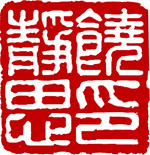
The Chinese poem by Yu Xin (513-581) titled "A visit to the newly built mountain land of the duke of Heyang" has had an effect on contemporary culture. The excerpt above reads:
Behind a rock in the dark probably hides a tiger, and the coiling giant root resembles a crouching dragon.
One translation of the four word phrase
Some thoughts on training and teaching, inspired by the above phrase:
It is best to not teach early in one's development or be too quick to accept the first opportunity to share one's skill. Without being very grounded in an art, it is easy to provide the wrong view of it to someone, which will color their perception of the practice. Beyond that, it is important to make sure you have a deep understanding of what you are doing before you try to share it. Sharing your practice is not simply repeating what you remember from when you yourself were being instructed. That is sort of a minimum on a surface level, but ideally your instructor was applying a process of discernment when they were instructing you. Repeating the gross pattern of that process, through the fog of memory, without a similar process of discernment or using good judgement, isn't going to wind up with the same outcome you experienced.
In my own case, I had good fortune with the first person I shared internal martial arts ideas with. He had been my student in the mix of Aikidō, Daitō-ryū Aiki-jujutsu and Shorinji Kempō I had learned in NYC. He was used to working with me and I think both appreciated the positive aspects of my approach and had patience with my limitations.
My first bagua teacher was kind enough to let me work with him on what I had learned, despite my inexperience — after I left my first dōjō, we reworked the Aikidō and Kempō we had been practicing, using what I felt was a better model for body mechanics and tactics than I had learned in NYC. With what I know now, I would say our approach was half external, half internal — for us at the time, it was not too far a bridge to cross.
I continued on to learn Tàijíquán, that was a path my student chose not to follow. He was willing to work with me on one thing, and keep large parts of what we had practiced together intact, but a total rewiring of everything, all the assumptions, was not in the cards — even if that would have allowed him to work with the people who were much better than me by attending the same classes I was.
I think the reason my first mentorship role in Baltimore worked out is I was operating from a basis of an approach (modern goshin-jutsu) I knew extremely well, with someone who had a similar background and skill. The process was then an exploration of how to approach and refine that curriculum with a relatively small set of teachings of Bagua that maybe were not as 'advanced' or 'high-level' as some of what I do now, but were more approachable, being closer to what we started with, and more easily explained.
Because my colleague already trusted me and wanted to keep working with me, he was willing to put up with me as I experimented with new ideas. He also provided clear feedback, and when sometimes things didn't feel correct, we worked together to come up with solutions. So, it began as a mentorship, as I had been his teacher, but by the end it was a collaboration and he could stand on his own as my peer.
That was probably the most successful experience I had as a novice teacher, one that has been difficult to repeat. I think this was because I was excited to continue what I was most interested in and had the least emotional encumbrance — but does not mean it was what I was best at, or most qualified to teach.
I later taught internal martial arts not to hold myself out as a teacher, but to simply continue my training. The lineage I am part of has some famous masters in its history, which sometimes attracts interest, but being a normal person and not a master means I can only provide a partial view of the promise of internal martial arts training.
In recent years I have had more success teaching kenjutsu informed by internal martial arts principles than internal martial arts themselves. I think this is because it is something closer to my earlier experience — half external, half internal — and easier for people to understand.
What then, if I do not have many people to work with on internal martial arts?
Skilled people talk about solo training, and all I can say is listen to what they say. What I add to that conversation as someone who is not a well-known teacher myself is not very important, other than to encourage the reader to stop, listen, and pay attention to the admonitions masters make about its value — the masters are right.
Now, when I do train with others in internal martial arts, it is mostly to: 1) visit senior Taiji colleagues to do application work with and share a little bit of what I have figured out to get their feedback, 2) talk at length with friends who practice internal martial arts and kenjutsu whose skill have eclipsed my own, and 3) return to my own Taiji instructor for further pointing out instructions along the way. The insights I obtain wind up being very valuable feedback to me in an endeavor that is otherwise largely solitary. In the case of kenjutsu, my teacher passed away last year, so much of this writing has to do with grappling with that fact, and what my path forward is.
When I visit one senior colleague's Taiji practice, and look at him and his students, I see them express such high quality movement that I know I made the right decision in stepping back from thinking of myself as an exemplar or teacher. My understanding slowly improves over time, and I have cultivated certain skills that work for me, but I am still far from a proper model to do justice to these matters for others.
I am grateful for the time to conduct solo practice and cultivate a greater sense of center and calm. I am also grateful for the few unscripted opportunities I have had to test my skill. They have shown me that indeed, continued solo practice works, even if I still have far to walk along the path.
After engaging in an impromptu freestyle grappling practice a few years ago — at a Lunar New Year's gathering I asked if anyone wanted to feel taijiquan and instead of asking for set or scripted attacks, I engaged in some free grappling with another teacher — a friend mentioned that either the teacher was going very easy on me or I was better than when we had both done push hands together a few years back. Likely both were true. It gave me a little more confidence to keep working at these kinds of skills, even if initially they seem difficult or unreliable compared to other approaches, or if my early efforts at teaching lead to frustration.
One metaphor for solo practice could be that of water polishing a stone over a very long time, but I appreciate the idea of hidden force or hidden skill, especially in internal martial arts, so the poem about the dragon and tiger came to mind. It is okay to remain hidden — not everyone needs to be a teacher — even if we are not as majestic as those archetypes of pure yin and pure yang.
A collected set of works on Shinkage-ryū heihō is available as a book: The Truth of the Calm Spirit: The practice of Shinkage-ryū Heihō as Taoist Internal Alchemy, 2025.