Aikidō and aiki-jūjutsu
I began training in Shukokai Karate in Elizabeth, NJ in 1980. After I moved to Flushing, NY, in 1988, I started practicing at a self-defense oriented Aikidō dōjō in Jackson Heights that augmented its practice with older Daitō-ryū techniques and striking methods (atemi) from Nippon Shorinji Kempō. It called itself a form of aiki-jūjutsu and atemi-jutsu but is best viewed as a form of goshin-jutsu — modern self-defense distinct from competitive grappling arts such as Brazilian jiu-jitsu that are now dominant. The school claimed to maintain a family tradition of aiki-jūjutsu that its earliest student manuals credit and thank Daitō-ryū as being its source.
There were a number of NYC area aiki-jūjutsu schools inspired by the teaching of Daitō-ryū Kodokai, especially Yonezawa Katsumi. I believe our school ultimately was a mixed martial art containing some Daitō-ryū techniques likely learned from seminars Yonezawa held in the 1970s. The core goshin-jutsu I learned was a preservation of locking and throwing methods drawn from 1950s era Aikidō, especially as practiced by Tohei Koichi, combined with striking methods drawn from karate and Shorinji Kempō that were both grafted onto a set of self-defense oriented body movements called tai-sabaki developed by Dennis Fink in the 1970s, which influenced many NYC area jūjutsu styles. Variants of Daitō-ryū jūjutsu techniques were layered on top of this structure — what I learned over time, especially after attending seminars in Daitō-ryū Takumakai in 1999, was that absent from the curriculum I had learned was any aiki-no-jutsu practice.
In November 2007 I reconnected with an old training buddy, Louis Bravo. Louis is a Hakko-ryū black belt who trained in karate and Aikidō before visiting our Jackson Heights aiki-jūjutsu dōjō on the recommendation of his father. His father is a Hakko-ryū practitioner who had heard of the school as teaching an art that was a variation on Miyama-ryū and effective for street fighting and self-defense.
I asked Louis to check what his father exactly knew about our school's history. Louis himself felt it was similar in some ways to the techniques he saw in Hakko-ryū and old Aikidō that were both derived from Daitō-ryū, but mixed with Karatedō and Judō:
I got a call from my old man and he gave me the missing link. Here is the breakdown... Sensei Claudio was the founder of Hoteikan-ryū. He worked with Sensei Perreira before he created Miyama-ryū. He was a Karate and Judo guy. Sensei Claudio worked out of several dojos including the basement in the Bronx [which had split off from Miyama-ryū] I told you about during this period.
Sensei Claudio met Sensei Robert Hasman and ran study groups around NYC in the 70s and 80s. Sensei Claudio was also a contemporary of Sensei William C. Morris, a sensei of Sosuishi-ryū and Danzan-ryū jūjutsu. They had a Black belt named David Samuel [the man our teacher initially claimed was his instructor]; he was a former Marine.
The art we studied was goshin-jutsu invented by Dennis Fink of Sosuishi-ryū Jūjutsu, Isshin-ryū karate, and Tomiki Aikidō that was mixed with Sensei Claudio's Karate and Judo and Sensei William C. Morris' old Danzan-ryū jūjutsu. The Basement dōjō and the first Hoteikan school was in a bank in the Bronx that is how our teacher came into the picture. The reason our teacher was not a Miyama-ryū guy is because he was part of the study group Sensei Claudio had in the Bronx.
Then in 2011, Lou was training in Chile and encountered someone who practiced Jūjutsu in NYC in the 1970s, and had some additional details:
I had a chance to meet with someone who was with our teacher in the early pre Jackson Heights days in New York. He told me the base for his art was Shorinji Kempō before Aikidō was added. He told me that the Aikidō was pre-war Aikidō, giving it more variations of throws, locks, etc. The weapons he was not sure on but said that the original goal was to be goshin-jutsu (self-defense).
He told me that even the story of Nishiyama passing away and his only daughter taking over the system was the true story of Shorinji Kempō whose head master is the daughter of the founder who died sometime in 1981 and the founder was in his own words a Warrior Monk. So both the Kempō and Aiki can be traced back to older systems of Japan and China. This is why the Atemi and Aiki work well for goshin-jutsu.
The guy told me that also at this time our teacher used the records of the Asahi Newspaper office in Osaka where many Daitō-ryū techniques were preserved on film as originally taught by both Ueshiba and Takeda Sokaku to make his art more solid and traditional. He told me that at this time the adding of arts or creating of a system was a big thing in NYC since it was the only way to stand apart from the big names schools in NYC like Oyama, Yamada, and Oishi.
I think the Aikidō and Sosuishi-ryū came first when he wanted to teach a goshin-jutsu art then the Shorinji Kempō completed the system we know today. The Hoteikan dojo from what I see looks like the lab / testing place for it and a few other NYC arts. I wanted you to know that what you spent so many years on was not a waste of time since we had variations of techniques that many of Aikidōka today have never seen. In closing, I now understand that it does have a real base but it's just that our teacher for some reason had to create a story for it and that is when I think the weapons part came into play.
Later, a former colleague began training under Dennis Fink of Sosuishi-ryū, whose self-defense teachings helped inspire many NYC area jūjutsu schools, including Miyama-ryū and its offshoots. Doing so, he discovered that many of the original stories or descriptions told in our dōjō were also taken in part from lives of teachers of Sosuishi-ryū. So, Shorinji Kempō was not the only art our teacher stole history from.
In NYC, I attended workshops from more direct lines of Daitō-ryū, including Daitō-ryū Takumakai, and came to realize what I had first learned in Jackson Heights, while effective for urban combatives, was an amalgamation instead of a traditional line of practice.
Haguro Shugendō and Daitō-ryū
The dōjō I trained at also maintained a set of religious practices under the mentorship of members of a family line of practice from Japan. This family history was borrowed by the martial arts school in an attempt to create a greater sense of authenticity to its martial practice.
Inner Dharma started largely not because of my practice of aiki-jūjutsu but because of my interest in Shugendō, a blend of Buddhism, Taoism, and mountain asceticism practiced in Japan. The arts taught at the dōjō I trained at in NYC were held by the instructors there to be derived from the fighting practices of Japanese yamabushi. This was invented. The claim was likely inspired from the fact that Takeda Sokaku's grandfather had (according to main-line Daitō-ryū writings such as Daitokan English language newsletters) been trained in Shugendō. Shugendō did have a strong philosophical influence on many classical Japanese martial arts, but there are very few yamabushi related martial traditions surviving in Japan — likely why this was chosen by a group trying to establish itself as interesting in the crowded NYC martial arts scene of the 1970s and 1980s.
Having since had contact with budō practitioners in Japan who actively practice Hagurō Shugendō, it is important to stress that aiki-jūjutsu schools in NYC in the 1980s had no formal relationship to Japanese Shugendō.
Visiting sacred places has been an important component of my
martial arts training over the years. It was in 2004, while visiting
the Dewa Sanzan area, including Gassan Dai Jinja (
Our teacher brought us to Japan on pilgrimage — we stayed first in Kawagoe at the parents of his friend and spiritual mentor, Ogawa Kyoko. We met with friends of his in Tokyo for dinner, who ran an English language school. They asked him how his Aikidō was going — this was a first warning sign something was amiss. They offered to send an interpreter who was a teacher at their school with us, to ease our travels. Our teacher was reluctant — a second warning. My colleagues and I insisted and we made our way north.
Kyoko I later learn was our teacher's spiritual mentor. She was a bilingual Japanese woman in New York whose family it seems may have maintained a partial line of Shugendō practice, or aspired to do so. A photograph of her grandfather, which hung in the family kamidana at their home in Kawagoe, was also displayed prominently in our NYC dōjō for many years — a direct borrowing of her family's religious identity into the school's martial arts presentation.
Pilgrimage to Dewa Sanzan
Evidence
suggests the martial art itself was our instructor's own creation. The
art was said to take its name as a shortened form of an
earlier name, Kazemura Yama Arashi Ryū. However, "Kazemura" is not a
historical Japanese name — it is a direct translation of the
instructor's own French surname into Japanese, with each component
rendered as its equivalent (kaze,
The family's Shugendō heritage, however, may be genuine. What appears to be fabricated is the connection between that heritage and the martial arts taught at the school.
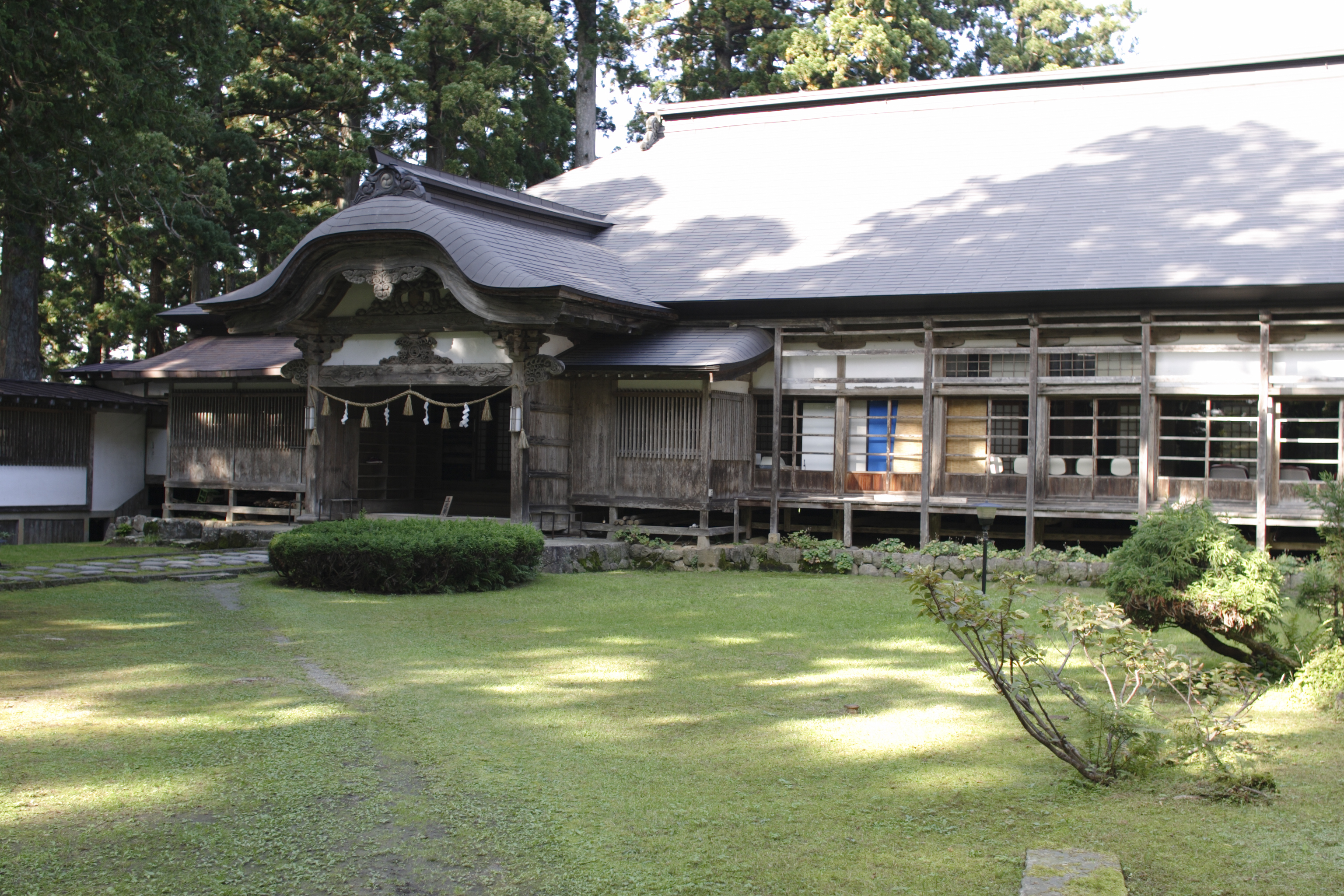
Inn Quarters adjacent to Gassan Dai Jinja
This was our second visit to Mt. Haguro. We visited the Gassan Dai Jinja and stayed at a country inn that used to be monks' quarters. We saw the pagoda at the base of Mt. Haguro and climbed the winding stone steps through the ancient cedar forest. That evening, our teacher presented us with our diploma, but said he was unable to reach the Shugendō practitioners that were to meet with us. He claimed to be furious that the people he knew did not want to meet his students. We were quite taken aback, given the time and expense we had made on this trip, all of us were from middle-class backgrounds and did not have money for trips to Japan to be casual endeavors.
This was the third warning, and a fourth rapidly followed. Our interpreter was horrified and went and got a Japanese phone book and found the phone number for Haguro Shugen Honshū and offered to call them the next day — he refused. We spoke to the shrine attendants next door and they also were concerned we could not meet up with the people we had been hoping to see, and offered to do a Shintō purification and blessing for us. My Japanese was middling at best, but I could tell they were concerned and helpful — our teacher said they were being rude, but I could tell they were concerned and using very polite speech with our interpreter. It was at that moment I became very concerned. Amusingly, in retrospect, there was a small sign advertising a Toyama-ryū Iaido class held in a conference room area on Sunday mornings. That was the only evidence of martial practice being associated with the shrine.
In some ways, that ceremony was the highlight of the trip, and the closest we got to a connection to Japanese mountain religion.
That evening our teacher told us he had a private matter to share — he had said he was one of a small group who had learned his martial art, but instead he was the only person left training, all others had stopped for one reason or another. He maintained the Shugenja in Japan wanted his line of practice to cease, but he wanted to keep the memory of what he had learned from his teacher alive. He provided us a hand-written letter in Japanese detailing the history of the foundation of our approach to martial arts, which contradicted earlier writing ascribing the influence to Daitō-ryū and Chinese kempō (which I later learned was Nippon Shorinji Kempō).
Shortly before the trip he had emailed us:
It was explained to me and you will handed a document that explains our history from Nishiyama Shiro. The old records were held by the Bettoh or superintendant of the Kaneiji temple in Tokyo which was affiliated with Haguro. This temple was burnt down because we resisted the decree of the restoration. Shiro started his own sect called Haguro Shugen Honshuu. This is the direction of his records and not based on martial arts ryu.
The importance at the time (should be today as well)was really to receive a title of shugenja, carry your shakujoh and wear the Haguro. The tradition names given to the martial arts practiced were created to identify a group of techniques practiced. The martial arts tradition names gained prominence when traditional warfare was forced to decline through centralization of government in the late 1800's. Also when the priesthood were forced to go into Shinto. There is no such a thing as Yama Arashi or any Ryu record of any significance prior to the mid 1800's. I probably have made an error in the past of making any connections to other traditions because of passing comments from my instructor and others. No one wants for us to connect to any martial arts tradition out there. I am sure there may be more for us to see in the future...
The handwritten letter in Japanese, dated 2005,
describes a family history tied to Haguro
Shugendō. In it, a 19th-century ancestor named Nishiyama is said to
have renamed an earlier tradition called Yama Arashi-ryū (
The Nishiyama Letter
The following is a transcription and translation of a handwritten Japanese letter dated September 5, 2005, recorded by or on behalf of, or using the name of, Nishiyama Akemi. This document was provided by the instructor of the aiki-jūjutsu school I trained at in NYC, to substantiate the school's claimed connection to Haguro Shugendō. Editorial commentary in brackets addresses the historical reliability of specific claims:
羽黒修験道 Haguro Shugendō
修験道の由来は、山奥で密教を修業する者達「修験者」が精神力向上する為の鍛練の道(お法)です。仏教、神道、道教そして陰陽占術が修業の基礎となっています。山の「神」は、教徒達が呼ぶ「権現」聖者と同格で神道と仏教が、完全にからみあった存在です。
The origin of Shugendō is the path of discipline by which those who practice esoteric Buddhism deep in the mountains — called shugensha — improve their spiritual power. Buddhism, Shintō, Taoism, and onmyō divination form the foundation of this practice. The mountain kami are beings called gongen by the followers — equivalent in rank to saints — in whom Shintō and Buddhism are completely intertwined."
The document opens with a general description of Shugendō as a syncretic tradition blending Buddhism, Shintō, Taoism, and onmyōdō that is broadly accurate and consistent with standard scholarship.
Separation of Kami and Buddhas
1868年、明治政府は全国の僧侶達に、神社での仏事をして仏に対しハ誓いをあきらめ、神社の神主の務めだけをする様に布告し、11日目後にはさらに二番目の布告、神である観現という地位の者達に仏教の教えを全部とりのぞく様に命令を出しました。この激変によって修験道は特に打撃を受け、布告に同調しかぬた山寺のほとんどは修験道寺でした。
In 1868, the Meiji government issued a proclamation to monks throughout the country ordering them to cease Buddhist rites at shrines, abandon their Buddhist vows, and serve only as Shintō priests. Eleven days later, a second proclamation was issued commanding those holding the position of gongen — a rank designating them as manifestations of the divine — to completely remove all Buddhist teachings. Shugendō was especially hard hit by this upheaval; most of the mountain temples that could not comply with the proclamation were Shugendō temples."
It continues with a historically accurate description of events during the late 19th century. The shinbutsu bunri (separation of kami and Buddhas) edicts of 1868 and the related haibutsu kishaku (abolish Buddhism) movement did devastate Shugendō institutions throughout Japan. The timing and general description are consistent with the historical record.
The Bettō of Kan'ei-ji
羽黒、カンデン総責任者(ベットウ)はこの新しい布告が一時的な規律と判断し、政府のさこうにしたがいませんでした。東京にある羽黒の系統に属しているカンエイ寺に助言を求めましたが、抵抗(反対運動)中に寺が焼けてしまいました。そして彼は自分が先頭をきって、布告のとおり神社の神主になり新しい規律を守って祈禱もつかさどり、自分の住いである寺では従来通り教徒を集めて修業をしてました。
The bettō (head administrator) of Haguro, Kanden, judged this new proclamation to be a temporary measure and did not comply with the government's policy. He sought advice from Kan'ei-ji, a temple in Tokyo belonging to the Haguro lineage, but during the resistance the temple was burned down. He then took the lead himself, becoming a shrine priest as the proclamation required, observing the new regulations and overseeing prayers, while at his own residence — the temple — he continued to gather followers and conduct ascetic training as before."
An academic paper on the Meiji-era separation at Haguro by Miyake
Hitoshi (published in the Meiji Seitoku Kinen Gakkai Kiyō) states that
the bettō of Haguro during the transition was named
His work confirms that the Tendai temple Arasawa-ji (the Shōzenin temple we visited the next day) was preserved as a Buddhist institution through the transition, and that a Hirata-school nativist scholar named Nishikawa Sugao was appointed as shrine priest (gūji) in 1873. No Nishiyama appears anywhere in the account, however, see below for some discussion about the orthography of Japanese names and how Nishikawa may have been the inspiration for the choice of the name Nishiyama:
- Nishikawa (
西川 ) —西 (nishi, west) +川 (kawa, river) — the historical figure appointed gūji in 1873 - Nishiyama (
西山 ) —西 (nishi, west) +山 (yama, mountain) — the family name in the letter - Ogawa (
小川 ) —小 (o, small) +川 (kawa, river) — maiden name
Nishikawa and Nishiyama share
That could be coincidence, or it could suggest her family actually does have some connection to the historical Nishikawa — perhaps a branch family or descendants — which would explain how they knew enough about the Haguro transition to write a letter that gets the broad strokes right while changing some key details to suit our teacher's narrative.
So one interpretation is that the Nishikawa family's real history at Haguro — as the government-appointed gūji who oversaw the forced transition — was lightly fictionalized into a "Nishiyama" ancestor narrative that reframes a state appointee as a reformist Shugendō monk with martial arts credentials. The instructor then adopted this fictionalized history as the origin story for an art whose name actually derives from his own French surname.
This is speculative, but the Nishikawa | Nishiyama parallel is hard to dismiss as coincidence given everything else.
Kan'ei-ji in Ueno, Tokyo, was affiliated with the Tendai establishment and was significantly damaged during the Battle of Ueno in July 1868 during the Boshin War, so the detail about the temple burning is historically plausible, but convenient in that records are thus removed from play. The description of the Haguro bettō attempting to navigate between compliance and preservation is consistent with the general pattern seen at many Shugendō sites during this period, though the specific name being glossed as Kanden instead of Kanda draws some suspicion.
Nishiyama Tashirō
勢力を持った山嵐流の僧侶、西山太志郎は月山モ三山神社と名づけて入山しました。彼の元で修行をしている僧侶と山伏達は、脱退するか神社の聖職者になるか選択を迫られた。西山太志郎は東京と地方で武術を教えながら生活の糧を得て妻と子供を養っておりました。彼の考えはだれからも同調されず、野望は完全に破れて羽黒へと帰郷しました。
A monk of the Yama Arashi-ryū who held influence, Nishiyama Tashirō, named the site Gassan-mo-Sanzan Jinja and entered the mountain. The monks and yamabushi training under him were forced to choose between leaving or becoming shrine clergy. Nishiyama Tashirō supported his wife and children by teaching martial arts in Tokyo and the provinces. His ideas found no support from anyone, and his ambitions completely shattered, he returned to Haguro."
This is where the narrative becomes difficult to verify. The claim
that a Shugendō monk supported himself by teaching martial arts is a
common trope in martial arts lineage stories — it provides a
plausible bridge between religious practice and martial
transmission. The name "Yama Arashi-ryū" (
Nikolai Mission to Japan
彼はロシアから布教にきていたニコライ教と天台宗に属している山伏達を召集して断圧し、復従させるに成功しました。彼は山伏達と岩根沢の村民から反発をかいはじめましたが、改善への意志はかたく、彼の御堂を神社として修業を行い、多くの人から非難を受けました。そして彼は山嵐流から風嵐流と変名しました。
He succeeded in summoning and suppressing the yamabushi who belonged to the Nikolai mission that had come from Russia to proselytize, as well as those of the Tendai sect, and brought them back into compliance. He began to face opposition from the yamabushi and villagers of Iwanesawa, but his resolve for reform was firm. He conducted ascetic practice at his own hall as a shrine, and received criticism from many people. He then changed the name from Yama Arashi-ryū to Fūran-ryū."
The reference to the Russian Orthodox "Nikolai mission" is historically grounded but odd — St. Nikolai (Ivan Kasatkin) established the Orthodox mission in Japan beginning in the 1860s, and the mission was active in northern Honshū. However, the claim that a Shugendō figure "suppressed" Orthodox-affiliated yamabushi is unusual. Orthodox Christianity had very limited penetration into yamabushi communities; this likely conflates separate historical phenomena.
Nikolai spent his first eight years in Japan (1861–1869) intensively studying Japanese language, history, and religion, including Buddhism. He viewed Japanese religions through a praeparatio evangelica lens — the early Church Fathers' concept that pre-Christian philosophy and religion served as a "nursemaid" preparing the ground for the Gospel. He respected the moral seriousness of Buddhism and Shintō without accepting their doctrinal claims. His first convert was actually a young Shintō devotee, a samurai named Sawabe Takuma, who had initially come to kill him but was so impressed by Nikolai's composure and arguments that he converted and became the first Japanese Orthodox priest. Many of his subsequent converts were former Buddhist monks.
Critically, his earliest and most committed Japanese disciples in the 1860s and 1870s were from the Tōhoku region — the same geographic area as Haguro. By 1874, he had about 400 converts. This means that during exactly the period the letter describes (the Meiji upheaval of 1868–1874), there was active Orthodox proselytization in the Dewa Sanzan region, targeting precisely the kinds of religiously committed people who were being displaced by the shinbutsu bunri edicts.
Yamabushi who had lost their institutional footing during the Meiji suppression could plausibly have been approached by or attracted to the Orthodox mission — both traditions value asceticism, monasticism, and hierarchical spiritual authority. From Nikolai's perspective, displaced yamabushi would have been promising converts: religiously serious, literate, disciplined, and suddenly without institutional support.
What remains implausible is the letter's framing — that a Shugendō figure "summoned and suppressed" Orthodox-affiliated yamabushi and brought them back into compliance. Nikolai's mission was small and his converts dispersed; there wouldn't have been an organized bloc of "Orthodox yamabushi" to suppress. But the underlying historical detail — that there was tension between Orthodox proselytization and traditional mountain religion in Tōhoku during this period — has a basis in historical reality.
This sharpens the picture of the letter: whoever composed it (or provided the oral account) knew enough about local Tōhoku religious history to include a real phenomenon — Orthodox missionary activity among displaced religious practitioners — but cast it in a way that aggrandizes the Nishiyama ancestor's role. It's the same pattern as the rest of the letter: real historical backdrop, fictionalized family narrative.
Aki-no-mine: Autumn Peak
1874年、西山は神社を守る流派を設立したところ、2パーセントの山伏が彼のもとへきただけでした。この流派の目的を神道の学びから離れて修業(鍛練)の道へと専念する事を決定しました。そしてそれ以来アキナミネは風嵐のグループに入って行なわれるのが伝統となりました。
In 1874, when Nishiyama established a school to protect the shrine, only two percent of the yamabushi came to join him. The purpose of this school was determined to be dedication to the path of ascetic training, departing from the study of Shintō. And since that time, it became tradition that the Akinamine would be conducted within the Fūran group."
Regarding the renaming from Yama Arashi or "mountain storm" to or "wind storm", changing a single kanji follows a common convention in Japanese lineage histories where a branch distinguishes itself through a small name change. Neither name, however, appears in standard references on Haguro Shugendō.
The Akinomine (
Secularization
西山は山伏にシャクジオを持つのを許可しました。そして彼の元で修業を望んでいる者達に伝統の上着の着服をしなくてよいはしましたがほどなくにほとんどの者たちは着る事をやめました。宗教の修業の変りに議論と講義が行われました。
Nishiyama permitted the yamabushi to carry the shakujō (ringed staff). Although he allowed those who wished to train under him to forego wearing the traditional upper garment, before long most of them stopped wearing it anyway. In place of religious ascetic training, discussion and lectures were conducted."
Permitting yamabushi to abandon traditional garments and replacing ascetic practice with "discussion and lectures" describes a secularization that runs counter to the entire purpose of Shugendō as a tradition of embodied mountain practice. This detail may serve to explain why a martial arts school derived from this lineage would not display recognizable Shugendō practice — a convenient explanation for the absence of authentic religious training.
Closing
風嵐流は西山家人によって管理されています。二つに割れた流派もこのままそれぞれの方向をとったままです。けれども二つの流派の関係もすこしずつよいかたに向っていますが一修験道という一本の糸が切れて二本になった為に、羽黒での合流は遠い夢の様です。
2005年9月5日 西山明美の録者
Fūran-ryū is managed by the Nishiyama family. The two divided schools continue to go their separate ways. However, the relationship between the two schools is gradually improving, but since the single thread of Shugendō was cut and became two, a reunion at Haguro remains a distant dream.
September 5, 2005 — Recorded on behalf of Nishiyama Akemi
The document closes with a poignant image of schism, which lends it emotional weight but also serves to explain why no one at the Haguro Shugendō institutions themselves would be likely to confirm the existence of Fūran-ryū — the two sides are estranged. This is a convenient narrative feature: it preempts verification.
The document presents itself as a family history recorded on behalf of a Nishiyama family member, and was possibly written by the NYC school's spiritual advisor — I increasingly believe she was the person named Nishiyama Akemi, but this matter remains unclear. If so, the family's Shugendō heritage may be genuine on its own terms. However, in the context of this essay's broader narrative — that the NYC dōjō appropriated family histories from Japanese sources to manufacture authenticity — the document's function is clear:
It provides enough verifiable historical backdrop (the Meiji persecution, the burning of Kan'ei-ji, the Nikolai mission) to seem credible, while the core claims about the Nishiyama family, Yama Arashi/Fūran-ryū, and their role in Haguro Shugendō cannot be independently verified through standard sources. The inclusion of martial arts teaching as a livelihood detail creates a convenient bridge between Shugendō and the martial arts instruction offered at the NYC school.
Complete Transmission
Another data point is our final martial arts ranking, called menkyo-kaiden (
風嵐流の伝統は山嵐流が用いた修験者の訓練法と八七四年羽黒修験本宗の修験道の部に基づく西山志郎家の伝統巻物と録に保持しその絶え間なき風村先生の許に貴殿に免許皆伝を授ける
The tradition of Kaze-arashi ryū is preserved in the training methods of the shugensha employed by Yama Arashi-ryū and in the traditional scrolls and records of the Nishiyama Shirō family, based on the Shugendō division of Haguro Shugen Honshū from 874. Under the unbroken [transmission of] Kazemura Sensei, this menkyo kaiden is hereby conferred upon you.
The document is dated October 10, 2005 — just five weeks after the Nishiyama family letter on September 5, 2005. The letter and the diploma appear to have been prepared together, the letter providing the historical narrative that the diploma then cites as its authority. The diploma explicitly claims continuity back to 874 — the year Shōbō founded Daigo-ji in Kyoto. This is the Tōzan-ha date, not a Haguro or Honzan-ha (Tendai) date, yet the certificate says "Haguro Shugen Honshū." The same conflation and possible mistake found in the 1999 student manual is embedded in the diploma itself.
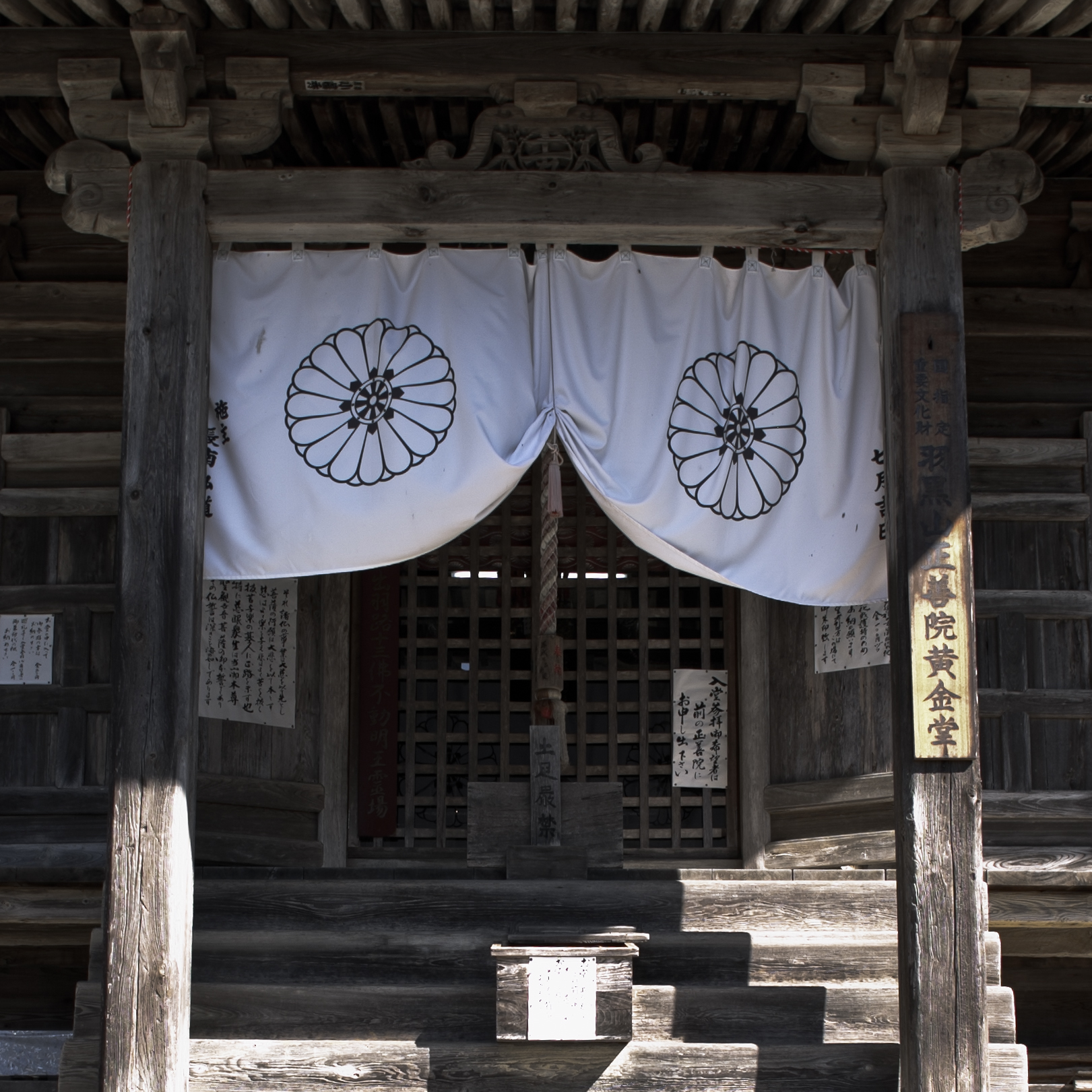
Haguro Shugen Honshū Shrine in Haguro-machi
The email and diploma narrative claims Tashiro Nishiyama (called Shiro elsewhere in student manuals) founded
Haguro Shugen Honshū, but that cannot be possible,
as he was said to live until 1932 and in contrast
The signatures on the diploma raise further questions:
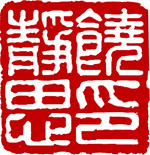
僧兵 小野明美 — Sōhei (warrior monk) Ono Akemi風村先生 — Kazemura Sensei with seal (hanko)ヘンリ・風村
Several things are worth noting. The hanko has instructor's given
name in katakana, and his adopted Japanese name Kazemura
directly visible on the seal. The signatory is listed as
Sōhei is an odd title, as sōhei were considered lower-level
warrior monks at Buddhist temples during the Heian and later periods,
not head abbots or leaders of religious movements.
A person holding genuine religious standing in a Shugendō context would use a title like
Ono is used with the same kanji as Ono-ha Ittō-ryū, a style of
sword supposedly practiced by Sokaku Takeda. Ono-ha Ittō-ryū (
- Kazemura (
風村 ) — translation of the instructor's French surname - Nishiyama (
西山 ) — possibly derived from Nishikawa, the historical Haguro gūji; used as the "budo name" - Ono (
小野 ) — the "real name," sharing its characters with Ono-ha Ittō-ryū, a sword school linked to Takeda Sokaku - Yama Arashi (
山嵐 ) — the signature technique of Saigō Shirō, adopted son of Saigō Tanomo, who is connected to Takeda Sokaku - Saigō Tanomo — appears in the 1999 manual as a direct teacher of the fictional Nishiyama Shirō
If Nishiyama is a "budo name" rather than an actual family name, then the family letter's entire premise — that Nishiyama is an ancestral surname going back to 19th-century Haguro — is contradicted by the school's own explanation. Either Nishiyama is the real maternal family name and the letter is a genuine family history, or Nishiyama is an adopted budo name and the letter is fiction dressed as family history. The two claims can't both be true, and the school apparently made both at different times depending on context.
Looked at in total, none of these names appear to be accidental. Each one was selected from the constellation of historical figures surrounding Takeda Sokaku and Daitō-ryū, then repurposed into a fabricated lineage. The "budo name" versus "real name" distinction conveniently allowed multiple borrowed names to coexist without contradicting each other — until you look at where they all point.
Generally, no Japanese person who trained in a legitimate school
would sign as "sensei" on a formal document.
Signing as sōhei on a menkyo kaiden suggests whoever chose the title was drawn to the martial-religious imagery — warrior monk sounds impressive in English — without understanding where sōhei actually sit in institutional hierarchy.
These are mistakes that someone with genuine training in either Japanese martial arts or Shugendō institutional culture would not make. The fact that the diploma's Japanese is otherwise competent (Akemi or Kyoko presumably wrote or helped draft it) but this error survived suggests that the instructor deliberately chose how he wanted to be identified and the calligrapher accommodated it, even though it is not how Japanese formal documents work.
So on one diploma we have: a French surname translated into Japanese, a family name that may be a one-character alteration of a historical Haguro figure, a self-applied honorific no Japanese practitioner would use, a warrior-monk title from the wrong level of the Buddhist hierarchy, a date (the 874 and Shōbō conflation) from the wrong Shugendō lineage, and possibly the spiritual advisor's name replaced with one borrowed from koryū kenjutsu history. Every single name and title on the document is fabricated or altered to serve the fiction.
Complete Break
We had been told for years there were other practitioners of our martial art in Japan, and historical records, teachings, and a temple in Japan we would one day visit. We instead were provided a window into the past. Mt Haguro was indeed important historically to the area, and many martial artists associated to Daitō-ryū and Aikidō made pilgrimage there. But that was the limit of the connection.
It was as if my teacher was finally coming clean. I told him at the time I would continue my practice, my one colleague was shocked and quiet, another in private the next day furious he had been manipulated.
The next day, I insisted we visit the Haguro Shōzenin temple in the nearby town. Our teacher said they would be unfriendly and that we should not go. There we met the Shugenja who was surprised and enthusiastic when I told him we practiced Shugendō in the United States — quite the opposite reaction. My reasoning at the time was that if our teacher had learned Shugendō from some source (such as his teacher or the Nishiyama family) and then the group had fallen apart, we could reconnect with a group that still met. Our teacher was as uncomfortable as I had ever seen him. I realized I could no longer train with him.
We left Japan dejected — I originally intended to simply fade from group commitments like intensive training weekends and quietly shift to spending more of my time on the Baguazhang I had been learning in Maryland. I knew where to find the Shōzenin and could go back there if I wanted to learn more about Shugendô.
It would not be so elegant. A week or two later, we received an email from one of the sempai of my instructor we had been told about for many years, who had also trained under David Samuel ("Sam" Nishiyama) in NYC. In the email, they encouraged us to continue training and not listen to other factions or persons on the internet. Out of suspicion, because of everything that had happened, and arguments I was getting into online about martial arts history (having defended the group publicly), I checked details of the email's headers, and they pointed to the same IP address our teacher used when emailing from work using his personal Yahoo account. It was then I realized, whether or not his sempai existed, he was impersonating them in order to manipulate us — I could no longer associate with him, regardless of the Shugendō history associated to the family of his friend. He had gone beyond misremembering details or political schisms to actively deceiving those around him.
After consulting with a friend and mentor, and sharing with him video footage of what we practiced, he confirmed that much of the art was an awkward combination of multiple influences, especially what was said to be medeival weapons of the yamabushi. I joined the online discussions questioning the approach no longer as a defender and lent my voice to the rising ire.
I realized I would have to find my own Shugendō, and much of my writing on Inner Dharma since that time has been concerned with exactly that.
Aiki Retrospective
What about the goshin-jutsu techniques?
Much later, I learned of a statement made by one of my first instructor's colleagues — someone who attended the Daitō-ryū Kodokai seminars taught by Yonezawa in the 1970s and eventually went on to learn Daitō-ryū Kodokai to an advanced level. He once told a prospective student who was contemplating the school I trained at in NYC and later trained with us on a private basis:
It's okay stuff. Good strong jūjutsu. Go do that first and get your black belt. Once you've learned the basics, then come to me if you want to learn real aiki. But, if I were you, I would not waste your time with their weapons practice. It is all made up.
I think that was a good summary. This information came to me from several sources around the time I consulted with senior Aikidō sensei in Maryland, showing them variations of the aiki-jūjutsu I had first learned in NYC — especially versions of locks and throws I had thought were quite unique. All were variations more commonly taught in the 1950s by senior experts like Tohei and Saitō.
Student Manuals
Some of the answers were staring at us all along. A careful reading of school manuals shows a progression of history being manufactured and altered about the martial arts they taught.
First, in 1979:
When his father died at sea at an early age, Nishiyama Akihiro was sent by his grandfather to learn Daito-ryû at the Daitôkan in Abashiri under Takeda Sokaku and Takeda Tokimune. Akihiro later became a sailor himself and learned martial arts in China. He was always interested in world reli- gions and spiritual practices. He founded Kazemura Yama Arashi-ryû while meditating and training on a mountaintop during a storm. His divine revelation was that one should not move through the storm as if fighting it, but become the storm itself. He renamed his art Kaze-arashi-ryû as a result. The preface of this manual thanks Takeda Sokaku for his efforts in creating Daitô-ryû:
“The members of the Kaze-arashi-ryu would like to extend our gratitude and devotion to the founders and members of the Daito-ryû system. For it is with the knowledge gained from them that our system was created.
By 1989, Daito-ryû is being de-emphasized but Shugendo not yet mentioned:
Nishiyama Shiro (1846-1932) is mentioned by name. He was born in Fukushima prefecture, orphaned as a young boy, and raised and educated at the Nikkô Toshogu Shrine. There he learned some methods of jô which were for coordination and meditation; i.e. not martial in character. An ex-Samurai general of the Aizu-han took an interest in him and taught him “Yama Kaze-Arashi-ryû”. He was awarded a menkyo-kaiden in weapons arts and unarmed combat called “oshikiuchi”. The Samurai general is not named. The manual states that later on Nishiyama’s instructor changed the name of the unarmed combat form of oshikiuchi to “aikijûjutsu” based on the doctrine of “aiki inyô hô”. The sword arts, called “tôhô” were renamed as “kenjutsu”. The priest’s staff, the spear (“sôjutsu”), and the naginata were all combined and called “jôjutsu”. Shiro taught his wife, children, and family members these martial arts.
In 1999, Shugendo is emphasized:
Nishiyama Shiro was educated by Shugendô priests on Mt. Haguro. He also studied on Mt. Yudono. He learned martial arts taught within a Shugendô sect founded by Shobo. When complet- ing his studies and still in his early studies, he taught at the Chidokan, a Sakai clan domain school in Tsuruoka. He later traveled as an instructor to high-level military personnel and government mem- bers. He met and studied with Saigo Tanomo at the Nikkô Shrine. Saigo was a former member of the Shugendô sect, and is remembered as an instructor of Takeda Sokaku, the founder of Daito-ryû. Nishiyama Akihiro was nicknamed Shitama because of a hunchback. He was a school principal. He traveled and visited many martial arts schools. He changed the names of the martial arts he learned from Shiro from Kazemura Yama Arashi-ryû to Kaze-arashi-ryû. The empty hand arts were called “aiki inyô hô” and the weapons arts were called “kenjutsu” and “jôjutsu”. He renamed the unarmed arts to “aikijûjutsu” and “atemijutsu.”
Several things stand out:
The Daitō-ryū connection is progressively laundered: In 1979, the relationship is direct and honestly stated: "our system was created" from knowledge gained from Daitō-ryū, with explicit thanks to Takeda Sokaku. By 1989, Daitō-ryū is no longer named — instead, an unnamed "ex-Samurai general of the Aizu-han" teaches Nishiyama Shiro the art, using the term "oshikiuchi," which is the Aizu domain term associated with Takeda Sokaku's own claimed lineage. By 1999, the connection is routed through Saigō Tanomo — a real historical figure documented as a mentor to Takeda Sokaku — whom Nishiyama Shiro supposedly met independently at Nikkō. This is lineage leapfrogging: instead of acknowledging descent from Daitō-ryū seminars in 1970s New York, the manual claims the school's ancestor learned directly from Takeda's own teacher, making them peers rather than students of students.
A founder then splits into two generations: In 1979 there is only Nishiyama Akihiro, who learns Daitō-ryū, goes to China, and founds the art. By 1989, Nishiyama Shiro (1846–1932) appears as a 19th-century ancestor — the dates conveniently placing him in the right era for Meiji history and Aizu domain connections. By 1999, Shiro and Akihiro are explicitly two generations, with Shiro as the historical ancestor and Akihiro as the descendant who renamed the art. The single invented founder has been pushed back a generation to create historical depth.
The Shōbō error: The 1999 manual says Shiro learned martial arts within a Shugendō sect "founded by Shobo." Shōbō (
The contrast between these two is exactly the point: anyone who had actually trained in Haguro Shugendō would know the difference immediately. The 1999 student manual's claim that Nishiyama Shiro learned martial arts within "a Shugendō sect founded by Shobo" conflates the Kyoto-based Tōzan-ha with the entirely separate Haguro tradition — an error unlikely from someone with genuine knowledge of Haguro Shugendō
Saigō Tanomo is made to do double duty: The 1999 manual describes Saigō Tanomo as both "a former member of the Shugendō sect" and "an instructor of Takeda Sokaku." The real Saigō Tanomo was the chief retainer (karō) of the Aizu domain — a political and military figure, not a Shugendō practitioner. His connection to Takeda Sokaku is documented in mainstream Daitō-ryū sources, but tagging him as Shugendō has no historical basis. This detail bridges the two fabricated lineages (martial and religious) through a single historical person, which is efficient fiction but bad history.
Geographic specificity increases with each revision: The 1979 manual is vague: Abashiri, China, a mountaintop during a storm. The 1989 manual adds Fukushima, Nikkō Toshogu, the Aizu domain. The 1999 manual adds Mt. Haguro, Mt. Yudono, Tsuruoka, and the Chidokan domain school. Each revision anchors the story in more real places, making it harder to dismiss offhand but also providing more specific claims that can be checked — and that fail verification.
The storm origin story persists but migrates: In 1979, "Kazemura Yama Arashi-ryū" is founded during a mountaintop storm meditation — a divine revelation that "one should not fight the storm but become the storm." This romantic origin narrative is the one thing that stays relatively stable, because it's the part that cannot be fact-checked. But by 1999 it has been pushed from Akihiro's founding moment to a mere renaming decision, subordinated to the now-elaborate Shugendō backstory.
NYC Training
The sin was not in teaching goshin-jutsu. Instead, by inflating the history to suggest it was a historical form of aiki-jūjutsu, advanced students who otherwise might have sought out traditional instruction instead wasted a lot of time and effort at the school's upper-level curriculum, which was largely invented and in retrospect, not of as high quality as traditional kenjutsu or aiki-jūjutsu as practiced in Japan or by people who studied in Japan.
In NYC, I recommend those interested in the Japanese martial art of aiki-jūjutsu train at The Yushinkan NYC located in Brooklyn led by Rodrigo Kong. Several friends I knew from New York changed to training there from our dōjō in Queens and were quite happy with their decision.
In 2012, I connected with an old training partner who stopped training regularly in goshin-jutsu around when I did. He has since been training at the Yushinkan in Brooklyn and learning authentic aiki-jūjutsu.
Initially, he liked Daitō-ryū but kind of missed the energy of the hard training found in the self-defense oriented style we had practiced. I spoke to him again two years later, to ask him his opinion of the waza we had first learned — specifically, I asked him if he thought they involved “aiki” in any way. From his updated understanding, he was quick to respond in the negative. In fact, now from practicing a more traditional approach, he is seeing more and more ways in which some of his earlier practice could be improved.
It is interesting to me that while I am practicing bagua and taiji, and he is practicing Daitō-ryū, we are coming to similar conclusions. I am sure a lot of our answers to the question of what might be done differently are not the same, but it is interesting that we are coming to similar conclusions nonetheless.
As for Shugendō? There are many more sources available in English now than in 2005, when I was reading a photocopy of H. Byron Earhart's early work, and the writings of Carmen Blacker. But, there are also fringe groups of various kinds — sacred mountains remain beautiful but at times can be perilous places to inhabit.
End Notes
- Miyake Hitoshi (
宮家準 ). "近現代の山岳宗教と修験道 ― 神仏分離令と神道指令への対応を中心に " [Mountain Religion and Shugendō in the Modern Era: Responses to the Shinbutsu Bunri Edicts and the Shintō Directive]. Meiji Seitoku Kinen Gakkai Kiyō (明治聖徳記念学会紀要 ), restored issue no. 43, November 2006, pp. 42–61. - Sekimori, Gaynor. "Paper Fowl and Wooden Fish: The Separation of Kami and Buddha Worship in Haguro Shugendō, 1869–1875." Japanese Journal of Religious Studies 32, no. 2 (2005): 197–234. [The definitive English-language account of the Meiji-era disruption at Haguro, which is directly relevant to evaluating the claims in the Nishiyama letter.]
- Sekimori, Gaynor. "Haguro Shugendō and the Separation of Buddha and Kami Worship (shinbutsu bunri), 1868–1890." PhD diss., University of Cambridge, 2000. [Sekimori's doctoral research covering the same period; no Nishiyama appears in her account.]
- Earhart, H. Byron. A Religious Study of the Mount Haguro Sect of Shugendō. Tokyo: Sophia University, 1970. [The foundational English-language study of Haguro Shugendō.]
- Blacker, Carmen. The Catalpa Bow: A Study of Shamanistic Practices in Japan. London: George Allen & Unwin, 1975. [Covers yamabushi practices in their broader shamanic context.]
- Miyake Hitoshi. Shugendō: Essays on the Structure of Japanese Folk Religion. Edited by H. Byron Earhart. Ann Arbor: University of Michigan Center for Japanese Studies, 2001.
- Keene, Donald. Emperor of Japan: Meiji and His World, 1852–1912. New York: Columbia University Press, 2002. [Covers the Battle of Ueno (July 1868) in which Kan'ei-ji was destroyed — corroborating the letter's claim about the temple burning.]
- Lensen, George Alexander. "The Russian Orthodox Mission to Japan." Chapter in Russia's Japan Expedition of 1852 to 1855. Gainesville: University of Florida Press, 1955. See also: Naganawa Mitsuo. "St. Nikolai of Japan (Ivan Kasatkin) and the Orthodox Mission in Northern Honshū." [Establishes the historical presence of the Nikolai mission in the Tōhoku region, relevant to evaluating the letter's claim about Orthodox-affiliated yamabushi.]
- Van Remortel, Michael, and Peter Chang, eds. Saint Nikolai Kasatkin and the Orthodox Mission in Japan. Point Reyes Station, CA: Divine Ascent Press, 2003.
- Pranin, Stanley, ed. Daitō-ryū Aikijūjutsu: Conversations with Daitō-ryū Masters. Tokyo: Aiki News, 1996. [Background on the Daitō-ryū lineages including the Kodokai branch under Yonezawa Katsumi that influenced NYC-area schools.]
- Pranin, Stanley. "Saigō Tanomo and Takeda Sokaku." Aiki News / Aikido Journal, various issues. [Documents the Saigō Tanomo connection to Takeda Sokaku and the claim that Saigō was connected to Shugendō, although Saigō Tanomo is now believed to not have practiced budō.]
- Saigō Shirō and the yama arashi technique: Saigō Shirō (1866–1922), adopted son of Saigō Tanomo, was a legendary early Kodokan Jūdō practitioner famous for his yama arashi (
山嵐 , "mountain storm") throw. His story was fictionalized in the popular novel Sanshirō Sugata (1942) by Tomita Tsuneo, later adapted as a film by Kurosawa Akira (1943). That the name of the art in the family letter — Yama Arashi-ryū — matches the signature technique of Saigō Tanomo's adopted son is unlikely to be coincidental, and further links the fabricated lineage to the periphery of Daitō-ryū history. - On Saigō Tanomo and Shugendō: Saigō Tanomo (1830–1903) was the chief retainer (karō) of the Aizu domain and a Shintō priest at Nikkō Tōshōgū after the domain's defeat in the Boshin War. His connection to Takeda Sokaku and the origins of Daitō-ryū remain disputed. See Pranin, Stanley, ed., Daitō-ryū Aikijūjutsu: Conversations with Daitō-ryū Masters (Tokyo: Aiki News, 1996). No mainstream source describes Saigō Tanomo as a Shugendō practitioner.
- There is a "Yama Arashi-ryū" (
山嵐流 , "mountain storm school") listed in the Bugei Ryūha Daijiten by Watanabe, but it has no detailed information associated to it in its entry. I was told by David Hall that this usually meant there was mention of an art somewhere in a primary reference, but it had died out without leaving further information. - On Sosuishi-ryū and the NYC goshin-jutsu scene: Sosuishi-ryū (
双水執流 ) is a legitimate classical Japanese martial art (koryū) with documented lineage. Dennis Fink's self-defense teachings in NYC in the 1970s drew from Sosuishi-ryū, Isshin-ryū karate, and Tomiki Aikidō, and influenced multiple NYC-area jūjutsu schools including Miyama-ryū and its offshoots. This is consistent with Louis Bravo's account of the NYC martial arts scene described in this essay. - Sō Dōshin (founder). The founder of Nippon Shorinji Kempō, Sō Dōshin (Nakano Michiomi), died in 1980. His daughter Sō Yūki succeeded him as head of the organization — the same succession narrative Louis's contact identified as having been appropriated by the NYC school.
- Shōbō (
聖宝 , 832–909), posthumously Rigen Daishi (理源大師 ), founded Daigo-ji in Kyoto in 874 and is the patriarch of the Tōzan-ha (当山派 ) branch of Shugendō, which is affiliated with Shingon Buddhism. He has no connection to Haguro Shugendō. See Miyake Hitoshi, Shugendō: Essays on the Structure of Japanese Folk Religion, ed. H. Byron Earhart (Ann Arbor: University of Michigan Center for Japanese Studies, 2001), and the Daigo-ji temple's own history at daigoji.or.jp. - Haguro Shugendō traces its founding to Nōjō Shōja (
能 除聖者 ), identified with Prince Hachiko (蜂子皇 子 , c. 542–641), son of Emperor Sushun. After his father's assassination by Soga no Umako in 592, the prince is said to have fled north and opened Mt. Haguro, Mt. Gassan, and Mt. Yudono as sacred sites for mountain practice. See Earhart, H. Byron, A Religious Study of the Mount Haguro Sect of Shugendō (Tokyo: Sophia University, 1970), and the Dewa Sanzan Jinja and Haguro-san Shōzenin institutional histories, both of which identify Nōjō Shōja — not Shōbō — as the founder. - Hagurosan Shugen Honshū (
羽黒山修験本宗 ) is the postwar institutional continuation of Haguro Shugendō, based at Arasawa-ji Shōzenin (荒澤寺正善院 ) in Tsuruoka, Yamagata Prefecture. It was reconstituted after WWII under Japan's 1947 constitutional guarantee of religious freedom, inheriting the tradition maintained at Shōzenin through the Meiji disruption. The claim of affiliation with Haguro Shugen Honshū refers to this specific, existing religious corporation — the same institution the author visited the day after receiving the diploma, where no one had heard of the NYC school. See hagurosan-shozenin.or.jp. - Why Haguro at all? Haguro's significance to the school was likely not drawn from any genuine Shugendō connection but from the fact that the Dewa Sanzan region was already a known pilgrimage destination among Daitō-ryū and Aikidō practitioners such as Takeda Sokaku, Okuyama Yoshiji of Hakko-ryū, Shirata Rinjirō, and Saitō Morihiro, making it a natural inspiring choice for someone later assembling a lineage from those sources.
Author's Note
One reason I am revisiting this essay and expanding it is because the group is still out there, and although there was a lot of negative publicity at the time, it was twenty years ago and some forums with that narrative are no longer available. The documents and travel show the lengths to which a teacher went to deceive his students. We weren't in a strong position to 'know better' at the time. This was not a case of students failing to do due diligence. It was a systematically constructed deception that evolved over twenty years, supported by a Japanese collaborator, several trips to Japan, documents provided in Japanese, and a fabricated history sophisticated enough to weave verifiable events around unverifiable claims.
A western student in the 1980s or 1990s — encountering a Japanese handwritten letter, a spiritual advisor who spoke Japanese, and a teacher who took them to Japan, introduced them to mutual colleagues and family members of friends, appeared to have been to Haguro before — would have had no reasonable basis to suspect something was amiss without observing the direct behavior of the teacher when some things did not go according to plan.